




- Uttarakhand Tours
- @Nagarjuna_Travels
What Makes Dol Ashram Special?
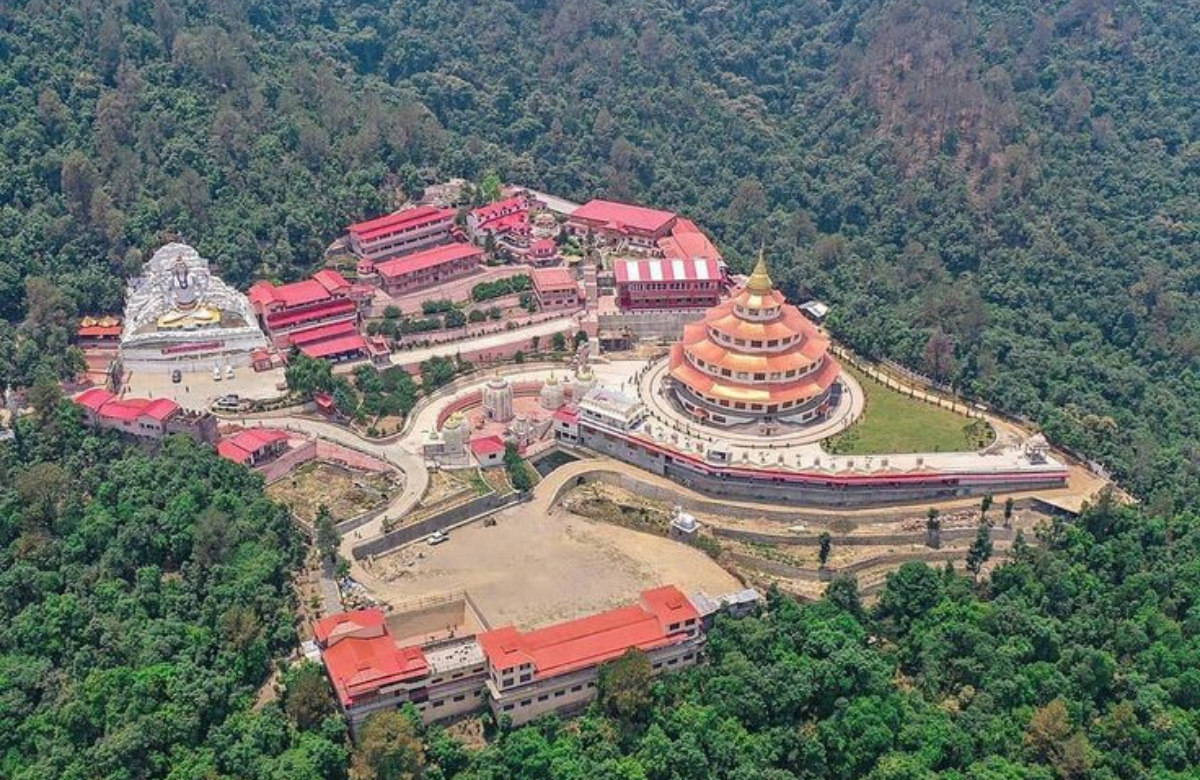
Dol Ashram is one of those Himalayan destinations that feels different from the moment the landscape begins to change around you. Instead of arriving at a crowded hill station filled with hotels, cafés, traffic and souvenir shops, visitors reach a spiritual centre surrounded by the forests and mountains of Uttarakhand. Officially known as Shri Kalyanika Himalaya Devasthanam, the ashram is associated with yoga, meditation, Vedic knowledge, Ayurveda and a broader philosophy of balancing physical, mental and spiritual wellbeing. Its official website describes the location as being surrounded by Himalayan forests and presents the ashram as a place for spiritual immersion and self-exploration. What puts Dol Ashram on the travel map, however, is its enormous Shri Yantra, installed in 2018 and widely described as the world’s largest or heaviest Shri Yantra. Reports from the time of its installation put its weight at approximately 1,670 kilograms, while several later travel sources commonly round that figure to about 1,600 kilograms. That combination of Himalayan scenery, traditional spiritual practice and extraordinary sacred geometry makes Dol Ashram much more than an unusual photo stop. It is a destination where architecture, symbolism, meditation and nature are intentionally brought together.
The World’s Largest Shri Yantra
The phrase “world’s largest Shri Yantra” is the headline that attracts many first-time visitors, but the object itself is more interesting than the superlative suggests. The Shri Yantra at Dol Ashram is not simply a gigantic decorative pattern enlarged for tourists; it is presented as a sacred object within a dedicated meditation environment known as the Shri Yantra Dhyana Peetham. Contemporary reports published around its installation in April 2018 described the structure as being made from ashta dhatu, traditionally meaning a combination of eight metals, and placed within a specially developed meditation complex. One report from 2018 recorded a claimed weight of 1,670 kilograms, while another described it as approximately 1.5 tonnes and around three and a half feet high. The difference between figures reported by different sources is worth keeping in mind when writing about the site: “about 1.6 tonnes” is a safer general description than treating one precise measurement as universally verified. What is not really in dispute is the scale of the installation and its central importance to Dol Ashram. The Shri Yantra occupies a position of spiritual focus, and the surrounding space is designed to encourage visitors to slow down, become quiet and contemplate rather than simply walk through as they might in a conventional tourist attraction.
The Numbers Behind the Shri Yantra
Numbers naturally become part of the fascination surrounding Dol Ashram because the Shri Yantra is physically enormous while also being constructed around an intricate geometric system. Reports published during the 2018 consecration described a 1,670-kilogram Shri Yantra, and travel references since then have frequently stated that the structure weighs around 1,600 kilograms. Sources also describe the wider Shri Yantra meditation complex as being capable of accommodating roughly 500 people for meditation, although dimensions and capacity figures vary between accounts. The important point is that Dol Ashram did not merely place a large metal yantra inside an ordinary room; it created an environment around it intended for contemplation and spiritual practice. That distinction helps explain why the attraction remains compelling even for visitors who do not approach the Shri Yantra from a particular religious belief. From an architectural perspective, the installation demonstrates how scale can influence human attention: something that might fit on a small household altar becomes monumental when expanded into a central object of meditation. From a spiritual perspective, devotees may understand that same scale differently, as a powerful manifestation of sacred geometry. In either case, the sheer physical presence of the Shri Yantra gives Dol Ashram an identity unlike most Himalayan temples and retreats.
Where Dol Ashram Is Located
Dol Ashram is located in Kanra village in the Almora district of Uttarakhand, in the Lamgara area, along the road connecting Almora with the Lohaghat and Devidhura side of the Kumaon region. A commonly cited travel reference places the ashram approximately 40 kilometres from Almora, although road-distance estimates vary depending on the starting point and route used. This variation is typical for mountain destinations, where a destination can be geographically close but take considerably longer to reach because of winding roads, elevation changes and local traffic conditions. The setting is part of the attraction: Dol Ashram sits amid forest rather than in the commercial centre of a town, creating a sense of separation from everyday urban life. The official ashram describes its surroundings as a pristine Himalayan environment with forests and natural beauty, and that landscape is an important part of the visitor experience. Travellers coming from Almora should therefore think of the journey as part of the destination rather than merely a transfer between two points. The road gradually changes the mood of the trip, and once visitors leave the busier areas behind, the combination of mountain air, trees and quiet makes it easier to understand why a spiritual institution was established here. Dol Ashram's location is not accidental decoration; the landscape itself is woven into its identity.
The Story and Spiritual Vision of Dol Ashram
The story of Dol Ashram is closely connected with Tapomurti Baba Kalyan Das Ji, whose spiritual vision shaped the institution and its broader mission. The official Shri Kalyanika platform presents the ashram as part of a larger effort to integrate spiritual wellbeing with ideas of physical and mental balance, while biographical accounts describe Baba Kalyan Das as a long-time ascetic who travelled extensively through India's sacred geography before developing institutions dedicated to service and spiritual education. Some accounts connect the inspiration for a Himalayan ashram with Baba Kalyan Das's pilgrimage experiences, including journeys associated with Kailash Mansarovar and a spiritual vision of the Divine Mother. Whether a visitor approaches that story as religious history, personal testimony or spiritual tradition, it provides an important key to understanding the character of Dol Ashram. The place was not conceived simply as a temple built around a spectacular object. Its stated purpose encompasses yoga, meditation, Vedanta, Vedic learning, Ayurveda, education and service, creating a much broader ecosystem of spiritual practice. That makes the Shri Yantra feel less like an isolated attraction and more like the centrepiece of an ongoing philosophy. Visitors who arrive expecting only a giant sacred symbol may therefore discover something more substantial: a functioning spiritual community where the yantra is connected to meditation, discipline, learning and reflection.
Baba Kalyan Das and the Ashram’s Mission
The vision associated with Baba Kalyan Das is important because it explains why Dol Ashram combines practices that modern travellers often treat as separate categories. Yoga is not presented merely as physical exercise, meditation is not treated only as stress relief, and traditional education is not separated completely from daily life. The official Shri Kalyanika material describes a mission centred on wellbeing and on integrating physical, mental and spiritual dimensions, while its wider community work includes educational institutions, gurukuls, healthcare initiatives, yoga centres and other forms of social service. The ashram's approach is therefore closer to the traditional Indian idea of a holistic spiritual institution than to a conventional retreat resort. That difference matters. At a resort, the goal may be to escape responsibilities for a few days; at an ashram, the goal is often to examine how one lives, thinks and acts. Dol Ashram's published daily routine illustrates that philosophy through an early start, prayer, yoga, study, service, gardening, evening worship and chanting. Such a schedule may look demanding to someone accustomed to a leisurely holiday, but that is precisely the point. The ashram experience is built around rhythm and discipline, encouraging visitors and residents to replace the fragmented pace of modern life with a more deliberate daily pattern.
From Himalayan Retreat to Spiritual Centre
Dol Ashram has developed into a place where several dimensions of Indian spiritual culture meet. Its natural setting provides the quiet atmosphere associated with Himalayan retreats, while its programmes bring structure through yoga, meditation, scriptural study and spiritual discourse. The ashram's official activities page lists beginner and advanced yoga and meditation programmes, meditation retreats, spiritual talks and celebrations connected with Hindu festivals and traditional observances. This makes the institution interesting even for travellers who are not specifically visiting to see the Shri Yantra. Someone interested in meditation may find the environment more important than the monument; someone interested in Indian philosophy may be drawn to the talks and study; and someone interested primarily in architecture or culture may find the Shri Yantra and its meditation hall the most memorable features. In that sense, Dol Ashram functions almost like a layered destination. The first layer is visual—the forest, temples, large Shiva statue and striking architecture. The second is cultural—the Sanskrit education, Vedic traditions and ceremonies. The third is contemplative—the silence, meditation and inward focus. The fourth is philosophical—the attempt to connect spiritual ideas with everyday wellbeing. Visitors can engage with one layer or several, which is why a short sightseeing visit and a deeper retreat can produce completely different experiences at the same place.
Understanding the Shri Yantra
To appreciate why the Dol Ashram installation matters, it helps to understand what a Shri Yantra actually is. The Shri Yantra, also called the Shri Chakra, is a sacred geometric diagram used in Hindu spiritual and Tantric traditions, particularly in practices associated with Devi and forms of the Divine Feminine. Rather than being a simple picture, it is traditionally understood as a structured representation of cosmic principles, with nine interlocking triangles arranged around a central point known as the Bindu. The wider design includes lotus petals, circles and an outer square with four gates, creating a visual system that moves the eye from the outside toward the centre. The Times of India has described the Shri Yantra as a sacred geometric form used in spiritual and religious practice and explained its nine-triangle structure and central Bindu. For someone seeing one for the first time, the geometry can look almost mathematical, and that is part of its appeal. Yet the traditional interpretation is not simply about mathematics or visual symmetry. The form carries layers of philosophical and religious symbolism, making it an object for worship, meditation and contemplation. At Dol Ashram, enlarging this form to monumental proportions turns an intricate symbolic diagram into an architectural experience where visitors can physically stand in relation to the geometry rather than simply look at a small representation.
The Meaning of Its Interlocking Triangles
The interlocking triangles are among the most recognisable features of the Shri Yantra, and their meaning is usually explained through the relationship between complementary principles. The upward- and downward-pointing triangles are traditionally associated with masculine and feminine aspects of divine reality, often discussed through the symbolism of Shiva and Shakti. Rather than imagining these as completely separate forces, the geometry expresses their interdependence: creation, consciousness and manifestation arise through relationship and balance. This symbolic reading is one reason the Shri Yantra has remained important within traditions of meditation and worship. The central Bindu represents a point of unity, while the surrounding triangles create increasingly complex layers between the centre and the outer boundary. The Times of India notes that the nine interlocking triangles are understood in connection with divine feminine and masculine energies. At Dol Ashram, this symbolism gains another dimension because the object is physically massive yet visually precise. A small Shri Yantra can be contemplated with the eyes; the giant Shri Yantra creates an almost architectural scale of contemplation. You do not merely glance at it and move on. The proportions, symmetry and repetition encourage the eye to settle. For devotees, that may support spiritual concentration. For visitors interested in sacred geometry, it offers a striking example of how a symbolic diagram can become the organising principle of an entire space.
Why the Bindu Matters
The Bindu, the central point of the Shri Yantra, is arguably the simplest visual element and one of its most significant symbolic features. At first glance, it seems almost too small to matter compared with the elaborate network of triangles surrounding it. Yet that contrast is precisely what makes the Bindu powerful within the traditional interpretation. The eye travels through layers of geometric complexity toward a single centre, creating a visual movement from multiplicity toward unity. In meditation traditions, concentration on a central point can also serve a practical purpose by giving the mind a fixed object of attention. The Shri Yantra's design therefore works on more than one level: it can be interpreted symbolically, contemplated visually and used as a meditation aid. At Dol Ashram, this becomes particularly compelling because the huge scale of the yantra does not eliminate the importance of the centre; instead, it makes the journey toward that centre feel even more dramatic. The entire structure can be understood as a visual map leading inward. That idea also fits the broader character of an ashram. You arrive from the outside world, enter a quieter environment, slow down, and eventually turn attention inward. The Shri Yantra can therefore be seen as a metaphor for the experience itself: complexity surrounds the individual, but contemplative practice attempts to discover stillness at the centre.
The Shri Yantra Dhyana Peetham
The Shri Yantra Dhyana Peetham is the purpose-built meditation space associated with Dol Ashram's enormous yantra. Reports about the 2018 installation described the meditation complex as capable of accommodating hundreds of people, with one source citing a capacity of around 500 practitioners. This is significant because it shows that the yantra was conceived as part of a collective spiritual environment rather than as a standalone monument. The word Dhyana refers to meditation, so the emphasis of the space is contemplative rather than theatrical. Visitors are expected to experience the yantra in an atmosphere of quiet and reverence, and recent travel coverage has reported restrictions on photography inside the area. That restriction may initially surprise travellers accustomed to photographing every landmark they visit, but it can also change the character of the experience. Without constantly thinking about getting the perfect photograph, visitors can pay more attention to the room, the geometry, the silence and their own reaction to the space. This is one of the reasons Dol Ashram can feel unlike an ordinary tourist attraction. The most important thing to do there may be nothing more complicated than sitting quietly. In a world designed around notifications, cameras and constant movement, a place that asks you to put the phone away can feel surprisingly powerful.
A Space Designed for Meditation
Meditation requires an environment in which attention can settle, and Dol Ashram's design appears to take that principle seriously. The ashram's published programme includes meditation retreats and yoga practices based on traditional philosophical frameworks, while its daily routine incorporates prayer, study, service and chanting. The Shri Yantra Dhyana Peetham adds a physical focal point to this approach. Instead of asking practitioners to meditate in an empty room, it provides a sacred geometric form around which the contemplative environment is organised. For some visitors, the visual complexity of the yantra may encourage concentration; for others, the stillness of the room may matter more than the geometry itself. There is no need to claim that the object produces scientifically measurable “cosmic energy” to appreciate why people can find the experience meaningful. Religious symbols can influence attention, emotion and behaviour because humans naturally respond to ritual, repetition, symmetry and meaningful spaces. Dol Ashram brings all of these elements together. The forest reduces external noise, the ashram routine reduces decision fatigue, the meditation hall provides a central object of attention, and the spiritual tradition supplies a framework for interpreting the experience. The result is an environment designed less for entertainment and more for intentional presence. Even a visitor who remains personally uncertain about the metaphysical claims surrounding the Shri Yantra can still understand its cultural and contemplative significance.
Why Visitors Come for Silence and Reflection
The appeal of Dol Ashram extends beyond people who already practise meditation or follow Hindu spiritual traditions. Many travellers today are looking for something that ordinary tourism struggles to provide: quiet. Hill stations can be beautiful but crowded, pilgrimage towns can be spiritually significant but busy, and luxury wellness retreats can be peaceful but carefully commercialised. Dol Ashram occupies a different space. Its forest setting, spiritual routine and emphasis on yoga and meditation create an atmosphere where the visitor is encouraged to reduce rather than increase stimulation. The official website explicitly frames the location around spiritual immersion, self-exploration and body-mind-soul alignment. That language may sound abstract until you experience what happens when the usual travel rhythm disappears. Instead of rushing from one viewpoint to another, you sit. Instead of collecting photographs, you observe. Instead of asking what attraction comes next, you have time to notice the sounds of the forest, the architecture and your own thoughts. This is why the Shri Yantra is most interesting when experienced in context. A giant sacred object in a crowded exhibition hall would have a completely different emotional impact. At Dol Ashram, the forests, temples, meditation traditions and silence form a single experience. The destination invites a slower form of tourism in which the absence of activity becomes part of the attraction.
Life and Activities at Dol Ashram
Life at Dol Ashram is structured around a combination of spiritual practice, study and service. The official programme provides a remarkably disciplined daily schedule, beginning at 4:00 a.m. and continuing through morning prayer, yoga, breakfast, scripture-related study, self-study, service work, gardening, evening worship, chanting and rest. This schedule gives a useful insight into the difference between an ashram and a conventional hotel. A hotel guest generally structures the day around personal preferences; an ashram resident or participant may follow a shared rhythm intended to cultivate discipline. Dol Ashram also offers beginner and advanced yoga programmes, meditation retreats and spiritual discourses covering texts and traditions such as the Upanishads, Bhagavad Gita and Bhagavatam. That range means the institution can appeal to people at very different stages of spiritual interest. A beginner may simply want to learn meditation, while a more experienced practitioner may be interested in intensive practice. A curious traveller might attend a discourse, explore the surroundings and spend some quiet time near the Shri Yantra. The important thing is that the ashram's activities are connected by a common idea: wellbeing is not treated as a product you purchase but as something developed through habits, attention, learning and disciplined living.
Yoga, Meditation and Vedanta
Yoga at Dol Ashram is presented in a broader philosophical context rather than being limited to stretching and fitness. The ashram's published activities describe yoga and meditation programmes rooted in Yoga and Vedanta principles, alongside meditation retreats and advanced practices. This approach reflects a traditional understanding in which yoga can involve the training of attention, ethical discipline and self-understanding as well as physical postures. For modern visitors, that can be an interesting contrast with the way the word “yoga” is often used commercially. At Dol Ashram, yoga sits within a larger ecosystem of prayer, meditation, study and service. The same environment that houses the world's largest Shri Yantra therefore becomes a place for practising the ideas symbolised by that sacred geometry. Someone visiting purely as a tourist does not have to become a dedicated practitioner to appreciate the distinction. Even a simple meditation session can reveal why the Himalayan environment is valuable: the reduced noise and slower pace create conditions that many people find difficult to reproduce in cities. The ashram's programme also suggests that spiritual practice is intended to continue beyond a single session. The emphasis on routine is a reminder that meaningful change is usually less like flipping a switch and more like cultivating a garden—small actions repeated consistently can gradually change the landscape of the mind.
Gurukul, Sanskrit and Traditional Learning
Another important aspect of Dol Ashram is its educational work, including traditional learning and Sanskrit-oriented education. Sources describing the institution note the presence of a Sanskrit Gurukulam intended to provide education to children, while the wider Shri Kalyanika organisation describes education as a major part of its social mission. This matters because it places Dol Ashram within a broader Indian tradition in which spiritual institutions have historically functioned as centres of learning as well as worship. The presence of education also changes how the destination should be understood. It is not simply a temple that happens to contain an unusual monument; it is an institution trying to preserve and transmit elements of cultural and philosophical heritage. For travellers interested in India's intellectual traditions, this educational dimension can be just as fascinating as the Shri Yantra itself. Sanskrit, Vedic literature, yoga philosophy and traditional practices are part of a long cultural continuum, and the ashram attempts to keep those subjects connected with everyday life. At the same time, visitors should remember that they are entering a functioning spiritual and educational environment rather than a theme park designed around tourist consumption. Respect for students, residents, teachers and religious spaces is therefore essential. The most rewarding visit is likely to be one in which curiosity is balanced by humility.
Visiting Dol Ashram
A visit to Dol Ashram works best when planned as a quiet cultural and spiritual excursion, rather than as a rushed stop between multiple sightseeing points. The ashram is in Kanra village in Almora district and is commonly described as roughly 35–40 kilometres from Almora town, depending on the route and reference point. Because the destination lies in a mountainous region, travellers should allow flexibility for road conditions and should avoid assuming that a short distance automatically means a very short journey. Road travel is the practical way to reach the area, with Haldwani and Kathgodam serving as important transport gateways for travellers approaching from the plains. One travel source places Kathgodam railway station at roughly 77 kilometres from Dol Ashram and Haldwani at about 83 kilometres, while Pantnagar Airport is listed at approximately 113 kilometres. These figures should be treated as approximate because routes can change and mapping services can calculate different distances. Once you arrive, the experience should be approached slowly. Wear comfortable clothing, carry water, and avoid planning an unrealistically packed itinerary. Most importantly, check the ashram's current visitor arrangements before travelling, particularly if you intend to stay, participate in a programme or visit a specific meditation session. The official Shri Kalyanika website is the best starting point for current information.
How to Reach Dol Ashram
For most visitors, the simplest approach is to travel first toward Almora, Haldwani or Kathgodam and then continue by road toward Kanra and the Dol Ashram area. A commonly cited route places the ashram on the Lohaghat–Devidhura–Almora Highway, around 40 kilometres from Almora. If you are travelling from Delhi or another major North Indian city, reaching Haldwani or Kathgodam by train or road can be convenient before hiring a taxi for the mountain portion of the journey. The mountain roads are part of the experience, but they also mean that travellers should avoid overly tight schedules. A road journey that looks straightforward on a map may take longer because of curves, weather, roadwork or local traffic. If you are visiting specifically for the Shri Yantra, it makes sense to confirm the current access schedule before leaving your hotel or accommodation. Recent visitor reports indicate that the Shri Yantra area can have restricted hours during the day, while photography and videography may not be permitted in the temple or meditation area. These rules can change, so they should be verified directly before a visit. The journey is best treated as a mountain excursion with a spiritual destination at its end, not as a quick city sightseeing trip. Give yourself enough time to arrive without rushing, spend meaningful time at the ashram and return safely before the mountain roads become difficult in darkness.
Best Time and Practical Etiquette
There is no single “perfect” month for everyone, but visitors generally prefer seasons when the Kumaon hills are comfortable for road travel and outdoor exploration. Some travel sources recommend October–November and February–March for visiting the broader Kumaon region, although personal preferences and weather conditions vary. Monsoon travel requires additional caution because mountain roads can be affected by heavy rain, while winter can bring colder conditions and shorter daylight hours. Regardless of the season, the most important preparation is cultural rather than logistical. Dol Ashram is a spiritual institution, so visitors should dress modestly, keep voices low in meditation areas, follow instructions from staff, avoid touching sacred objects unless invited, and respect photography restrictions. The Shri Yantra should be approached as a religious object, not merely as an oversized curiosity. If you see people meditating, give them space rather than interrupting for photographs. If a particular area is closed, accept the restriction without argument. These simple habits can make the visit more comfortable for everyone. The goal is not to behave like a pilgrim if that is not your personal tradition; it is simply to recognise that you are a guest in a sacred environment. A respectful traveller can remain curious, take in the architecture and learn about the symbolism while allowing the place to retain the quiet character that makes Dol Ashram special.
Why Dol Ashram Matters for Modern Travellers
Dol Ashram represents a kind of travel experience that is becoming increasingly valuable in an age of constant digital stimulation. People often travel to the mountains hoping to escape noise, yet they carry the same noise in their pockets through phones, notifications and social media. A destination built around meditation creates an opportunity to break that cycle, even temporarily. Dol Ashram's official philosophy explicitly focuses on the balance of body, mind and soul, while its programmes emphasise yoga, meditation, study and disciplined daily living. The enormous Shri Yantra gives that philosophy a physical centre. It is difficult to stand before an object of that scale without noticing its geometry, symmetry and presence. Whether a person interprets the yantra through faith, symbolism, art or psychology, the experience encourages attention. That is perhaps the most interesting reason to visit. The destination is not valuable merely because someone has labelled it “the world's largest.” Its deeper appeal comes from the relationship between the monument and the environment around it. The forest provides quiet, the ashram provides structure, the yantra provides focus, and the surrounding spiritual traditions provide meaning. Together they create an experience that is difficult to replicate in a conventional tourist attraction. Dol Ashram therefore fits naturally into the growing interest in slow travel, wellness travel, cultural tourism and meaningful journeys where the destination is expected to offer something more than entertainment.
A Different Kind of Himalayan Experience
The Himalayas are famous for dramatic landscapes, pilgrimage centres, trekking routes and hill stations, but Dol Ashram offers a different version of Himalayan tourism. Here, the attraction is not primarily a mountain peak or adventure activity. Instead, it is the interaction between nature, sacred geometry and contemplation. The official ashram describes its setting as a pristine Himalayan environment surrounded by forests, and this natural context is central to the experience. The giant Shri Yantra adds an extraordinary human-made element to that landscape. Nature is irregular, constantly changing and difficult to control; the yantra is highly ordered, symmetrical and deliberately constructed. Placing the two together creates an intriguing contrast. The forest moves with wind, weather and seasons, while the sacred geometry remains fixed at the centre of the meditation space. For a traveller, that contrast can become part of the reflection. Modern life often oscillates between chaos and rigid schedules, while contemplative traditions seek a more balanced relationship between activity and stillness. Dol Ashram expresses something similar through its physical environment. You travel through winding roads and changing landscapes to arrive at a place that asks you to stop. You move from the complexity of the outside world toward the geometric centre of the Shri Yantra. The journey itself becomes a transition from movement to stillness, which may be the most memorable feature of the entire experience.
Spiritual Tourism Beyond Sightseeing
Spiritual tourism is sometimes misunderstood as simply visiting famous temples, taking photographs and moving to the next attraction. Dol Ashram suggests a different model. The destination combines a major religious symbol with opportunities for meditation, yoga, study and quiet reflection, meaning that the visitor can participate rather than merely observe. The ashram's official programme includes beginner and advanced practices, meditation retreats, spiritual discourses and traditional celebrations. This makes the site particularly relevant to travellers who want to understand rather than simply see. You can ask what a Shri Yantra means, why its geometry is significant, how meditation is practised and how traditional Indian spiritual institutions structure daily life. Those questions turn sightseeing into learning. At the same time, visitors do not need to accept every religious belief to appreciate the cultural significance of the place. A cathedral can be architecturally fascinating to someone who is not Christian, and a Buddhist monastery can be culturally meaningful to someone who does not practise Buddhism. The same principle applies here. Dol Ashram can be approached through religion, philosophy, architecture, history, wellness or travel. Its greatest strength is that these perspectives overlap rather than compete. The world's largest Shri Yantra may be what gets you to Dol Ashram, but the combination of Himalayan nature, traditional practice and silence is what can make the destination stay in your memory long after you have left.
Conclusion
Dol Ashram is a remarkable destination because the world's largest Shri Yantra is only the beginning of its story. Located in the forests of Almora district in Uttarakhand, the ashram brings together sacred geometry, meditation, yoga, Vedic learning, traditional education and a distinctive Himalayan setting. The Shri Yantra was installed in April 2018, with contemporary reports giving its weight at around 1,670 kilograms and later sources commonly describing it as roughly 1.6 tonnes. Its nine interlocking triangles and central Bindu represent a sophisticated symbolic system that has been used for contemplation and spiritual practice for generations. At Dol Ashram, that symbolism becomes physically monumental, turning a traditionally compact sacred diagram into the centrepiece of a dedicated meditation environment. Yet the real appeal of the place is the way everything fits together. The forests create solitude, the ashram provides discipline, the meditation hall provides focus, and the Shri Yantra gives visitors a powerful visual expression of sacred geometry. If you are planning a trip to Uttarakhand and want an experience beyond conventional hill-station sightseeing, Dol Ashram deserves consideration. Go with enough time to slow down, respect the spiritual character of the place, follow current visitor rules and allow yourself to experience the silence. The giant Shri Yantra may be the headline, but the deeper attraction is the invitation to pause, look inward and experience the Himalayas at a much quieter pace.
FAQs
1. Where is Dol Ashram located?
Dol Ashram, officially known as Shri Kalyanika Himalaya Devasthanam, is located in Kanra village in the Almora district of Uttarakhand, in the Lamgara area. Travel sources commonly place it roughly 35–40 kilometres from Almora by road, although the exact distance depends on the route and starting point. The ashram is surrounded by Himalayan forest and is positioned away from the busiest tourist centres, which contributes significantly to its peaceful atmosphere. Travellers generally reach the area by road after arriving in Almora, Haldwani or Kathgodam. Because mountain travel times can vary, it is sensible to allow extra time rather than planning the journey around a tightly fixed schedule. The official Shri Kalyanika website should be checked before travelling for current information about programmes, accommodation, access and visitor arrangements.
2. Why is Dol Ashram famous?
Dol Ashram is best known for housing what is widely described as the world's largest or heaviest Shri Yantra. The Shri Yantra was installed at the ashram in April 2018, and reports from that period described a structure weighing approximately 1,670 kilograms. Beyond the yantra itself, Dol Ashram is a spiritual centre associated with yoga, meditation, Vedanta, Vedic learning, Ayurveda and traditional education. Its forest setting adds another major attraction, especially for travellers looking for quiet rather than crowded sightseeing. The institution also conducts spiritual programmes, meditation retreats and educational activities, giving visitors opportunities to engage with Indian philosophical and spiritual traditions rather than simply view a landmark.
3. What is special about the Shri Yantra at Dol Ashram?
The Shri Yantra at Dol Ashram is special primarily because of its extraordinary physical scale and its role as the focal point of a dedicated meditation complex. Reports from its installation described it as being made from ashta dhatu, traditionally referring to eight metals, and weighing around 1.5–1.67 tonnes depending on the source. The Shri Yantra itself is a sacred geometric design consisting of nine interlocking triangles surrounding a central Bindu. At Dol Ashram, the traditional geometry becomes a monumental object that visitors can experience within a meditation-oriented environment. This combination of size, symbolism and setting is what makes the installation unusual.
4. Is photography allowed inside the Dol Ashram Shri Yantra temple?
Visitors should not assume that photography or videography is permitted inside the Shri Yantra meditation or temple area. Recent travel coverage has reported photography restrictions in the premises, and visitor reviews have also mentioned restrictions around the Shri Yantra area. Rules can change, so it is best to follow the instructions displayed at the ashram or given by staff when you arrive. Even when photography is permitted in outdoor areas, visitors should avoid photographing people engaged in prayer or meditation without permission. The most respectful approach is to treat the Shri Yantra as a sacred object first and a tourist attraction second.
5. What can visitors do at Dol Ashram besides seeing the Shri Yantra?
Dol Ashram offers much more than a visit to the giant Shri Yantra. Its official programme includes yoga, meditation, spiritual discourses, meditation retreats, study and traditional ceremonies, with programmes ranging from beginner activities to more advanced practices. The ashram is also associated with Sanskrit and traditional education, while the broader Shri Kalyanika organisation describes education and social service as important parts of its mission. Visitors interested in spirituality can therefore explore the destination as a place of learning and reflection rather than treating it as a quick sightseeing stop. The surrounding Himalayan forest also provides a peaceful environment for anyone who simply wants to slow down and spend time away from the noise of city life.