

- Asia Travel Blogs
- Chandan_singh
You search for "famous temples in Cambodia" and get a flood of names. Angkor Wat. Bayon. Ta Prohm. Banteay Srei. Then come the unfamiliar ones: Koh Ker, Preah Khan, Pre Rup. Which are Hindu? Which are Buddhist? Which are worth a full day? Do you need one day or five? Most guides list temples like a shopping catalogue. They skip the story. They do not tell you why Hindu gods are carved into walls of a country that is now over 95% Buddhist. They do not tell you how to beat the heat, the crowds, or the ticket confusion.
Where Are the Famous Temples in Cambodia? Location & Geography
Cambodia's best-known temples cluster in the northwest of the country, on the plains north of Tonlé Sap, the great freshwater lake. This was the heartland of the Khmer Empire. The empire's capitals rose here because the lake gave rice, fish and water for vast reservoirs called barays.
Key Location Facts
- Country: Kingdom of Cambodia
- Main hub: Siem Reap (Siem Reap Province)
- Main site: Angkor Archaeological Park, UNESCO World Heritage Site since 1992
- Distance from Siem Reap to Angkor Wat: about 6 km
- Nearest airport: Siem Reap-Angkor International Airport, roughly 40 km from town
- Distance from Phnom Penh to Siem Reap: about 310 km by road (5–6 hours)
- Distance from Bangkok to Siem Reap: about 400 km by road via the Poipet border; flights are faster
- Climate: tropical, with a dry season (November–April) and a rainy season (May–October)
Distances From Siem Reap to the Major Temples
| Temple | Approx. Distance from Siem Reap | Drive Time |
| Angkor Wat | 6 km | 15 mins |
| Angkor Thom / Bayon | 8 km | 20 mins |
| Ta Prohm | 10 km | 25 mins |
| Banteay Srei | 35 km | 50–60 mins |
| Kbal Spean | 50 km | 1–1.25 hrs |
| Roluos Group (Bakong) | 13 km | 25 mins |
| Beng Mealea | 65–70 km | 1.25–1.5 hrs |
| Koh Ker | 120 km | 2–2.5 hrs |
| Preah Vihear | 230+ km | 4–5 hrs |
| Sambor Prei Kuk | 170–180 km | 3–3.5 hrs |
History of the Hindu Temples in Cambodia
The story of the Hindu temples in Cambodia is the story of how Indian religion, language and art became Khmer. It involves kings, Brahmins, traders, stone masons and a thousand years of change.
Indian Influence Reaches Southeast Asia
From the early centuries CE, Indian traders and priests travelled by sea to the coasts of Southeast Asia. They brought Sanskrit, Hindu gods, Buddhist teaching, royal rituals and ideas about kingship. Local rulers adopted them. Early kingdoms such as Funan and Chenla used Sanskrit in their inscriptions and honoured Shiva and Vishnu. Sambor Prei Kuk, the capital of Chenla under King Isanavarman I in the early 7th century, shows this stage. Its brick towers, some of them octagonal, are among the oldest Hindu temples in Cambodia.
The Birth of the Khmer Empire (802 CE)
In 802 CE, Jayavarman II declared himself universal ruler on the sacred hill of Phnom Kulen. He introduced the cult of the devaraja, or "god-king". Under this belief, the king ruled through a link with a deity, usually Shiva, represented by a linga. Each ruler built a "temple-mountain" to house that link. The temple stood for Mount Meru, the mythical home of the gods.
The Great Temple-Builders
- Indravarman I (877–889): built Preah Ko and Bakong at Roluos (Hariharalaya), the first great sandstone temple-mountain.
- Yasovarman I (889–c. 910): moved the capital to Angkor and built Phnom Bakheng on a hill as its centre.
- Rajendravarman II (944–968): built Pre Rup and East Mebon. During his reign, the courtier Yajnavaraha founded Banteay Srei (967 CE).
- Jayavarman IV (928–941): moved the capital to Koh Ker and built the 7-tier pyramid there.
- Suryavarman I and later kings (11th century): expanded Preah Vihear.
- Suryavarman II (1113–c. 1150): built Angkor Wat for Vishnu. Beng Mealea is from the same era.
- Jayavarman VII (1181–c. 1218): a Mahayana Buddhist who built Angkor Thom, Bayon, Ta Prohm and Preah Khan.
From Hindu to Buddhist
Religion at Angkor shifted over time:
- 9th–12th century: Shiva worship dominated, with Vishnu prominent under Suryavarman II.
- Late 12th century: Jayavarman VII promoted Mahayana Buddhism.
- 13th century: A Hindu revival followed, and many Buddhist images were defaced.
- 14th century onward: Theravada Buddhism spread and became the main faith of the Khmer people.
Angkor was weakened by war, climate stress and shifting trade routes. After the Siamese attacks of 1431, the court moved south. Angkor Wat, however, was never fully abandoned. Buddhist monks kept it alive.
Hinduism in Cambodia Today
Cambodia is overwhelmingly Theravada Buddhist, and the Hindu community is small. Hindu traditions still echo in Khmer life. Royal Bakou Brahmins perform rites at ceremonies such as the Royal Ploughing Ceremony. Stories of the Reamker, the Khmer Ramayana, shape dance, theatre and shadow puppetry.
India's Role in Restoration
The Archaeological Survey of India (ASI) has worked on the Angkor temples for decades. It restored parts of Angkor Wat in the 1980s and 1990s. From the early 2000s, it led conservation work at Ta Prohm. For many Indian visitors, this adds another layer of pride to the visit.
Hindu Temple Angkor Wat in Cambodia: The Crown Jewel
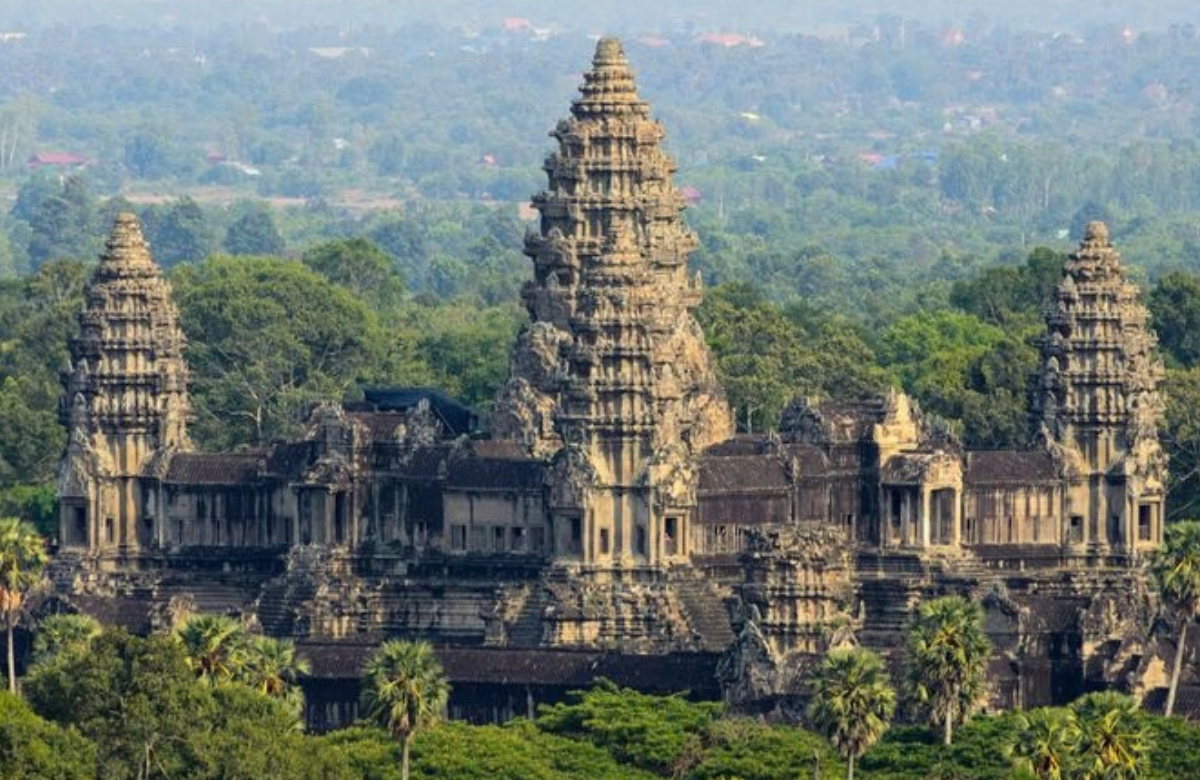
Hindu temple Angkor Wat in Cambodia is the answer to most searches about Cambodian temples, and rightly so. The name means "City Temple" or "Temple City". King Suryavarman II built it in the first half of the 12th century as a state temple and, many scholars believe, a funerary monument. It is dedicated to Lord Vishnu.
Angkor Wat at a Glance
- Built: early 12th century
- Dedicated to: Vishnu
- Style: classical Angkor Wat style
- Material: sandstone blocks, many brought from quarries at Phnom Kulen, with laterite for the foundations
- Site size: about 162 hectares
- Moat: about 190 m wide, enclosing the temple on all sides
- Central tower: rises roughly 65 m above ground level
- UNESCO status: part of the Angkor World Heritage Site (1992)
- Orientation: faces west, unusual for Khmer temples and linked by many scholars with Vishnu and with funerary meaning
The Design: Mount Meru in Stone
The temple is built to represent Mount Meru. Five towers rise like lotus buds. Four corner towers circle a central tower. The moat stands for the cosmic ocean. Three rectangular galleries step upward toward the sanctum. Each level feels holier and more private than the last.
The Bas-Reliefs: The Ramayana and Mahabharata in Stone
The outer gallery holds one of the longest continuous stone bas-relief carvings in the world. It tells Hindu epics and royal history. Do not miss:
- Churning of the Ocean of Milk: gods and demons pull the serpent Vasuki to produce the nectar of immortality, with Vishnu supporting the mountain as a tortoise. This is the most famous panel.
- Battle of Kurukshetra: the Mahabharata war between the Kauravas and Pandavas.
- Battle of Lanka: Rama's army fights Ravana's forces from the Ramayana.
- Heaven and Hell: the rewards and punishments awaiting souls.
- Procession of Suryavarman II: the king with his army and court.
- Vishnu's battle with demons: divine warfare in carved detail.
The Apsaras
Over 1,700 carvings of apsaras, heavenly dancers, decorate the walls. Each has a different hairstyle, jewellery and expression. They are among the most loved details of the temple.
A Living Temple
Angkor Wat appears on the Cambodian national flag. Monks in orange robes still walk its galleries. Visitors can see Buddha statues placed in its corridors long after the Hindu builders passed.
Angkor Wat Visitor Tips
- Sunrise: arrive well before dawn to find a spot at the reflecting pond. The sky behind the five towers is spectacular.
- After sunrise: most tour groups leave for breakfast. Explore the bas-reliefs while the light is still soft.
- Late afternoon: crowds thin and the sandstone glows warm.
- Upper level (Bakan): access is limited. There is a timed entry, a dress code and age rules. Check on arrival.
- Guide: a licensed guide makes the carvings come alive, especially the Hindu epics.
Other Hindu Temples in Cambodia Worth Visiting
Banteay Srei: The Jewel of Khmer Art
Founded in 967 CE, Banteay Srei is a Shiva temple made of fine-grained pink sandstone. It is small but astonishing. Every surface is carved in deep, delicate relief: floral patterns, deities, and scenes from the Ramayana and Mahabharata. Look for Ravana shaking Mount Kailasa and Krishna slaying Kamsa.The name means "Citadel of the Women", a nod to its fine carving. In 1923 the French writer André Malraux tried to remove some carvings and was arrested, which brought international attention to the temple.
Tip: go early or late to avoid tour buses. The pink stone glows in morning light.
Phnom Bakheng: The Sunset Temple
Built by Yasovarman I around 900 CE on a hilltop, Phnom Bakheng is a Shiva temple-mountain. It was the centre of the first city at Angkor. Many visit at sunset for views over the forest canopy toward Angkor Wat. Visitor numbers are controlled, so arrive early.
Pre Rup and East Mebon
These two 10th-century Shiva temples are built from red brick and laterite. They are quieter than the big temples and are good places to see Angkor's early architecture. Pre Rup is popular at sunrise or sunset.
Prasat Kravan: Vishnu in Brick
This small 10th-century brick temple (921 CE) is dedicated to Vishnu. Its interior holds rare brick carvings of Vishnu in different forms, including as Vamana. It is quick to visit and rewarding for those interested in Hindu iconography.
Banteay Samre
This 12th-century temple resembles Angkor Wat in style but is much smaller and quieter. Its carvings include scenes from Hindu epics, and it is a good stop for those who want to see the Angkor Wat style up close.
Bakong and the Roluos Group
The Roluos group, about 13 km from Siem Reap, includes Bakong, Preah Ko and Lolei. They date to the late 9th century, when the Khmer capital was called Hariharalaya. Bakong, a five-tiered pyramid, was Indravarman I's state temple. Preah Ko is guarded by statues of Nandi, Shiva's sacred bull.
Beng Mealea: The Jungle Hindu Temple
Beng Mealea is a large 12th-century temple from the age of Suryavarman II, close in style to Angkor Wat. It has been left largely as nature reclaimed it. Trees grow through galleries, and blocks lie in heaps. Visitors can clamber on wooden walkways and stone piles. It lies about 65–70 km east of Siem Reap. Check whether a separate entry fee applies.
Koh Ker: The Hidden Capital
For a short time in the 10th century, Koh Ker was the capital of the Khmer Empire. Its main attraction is Prasat Thom (Prang), a seven-tiered stepped pyramid about 35 m high. The site has many other Hindu temples scattered in the forest, with beautiful carved lintels. UNESCO inscribed Koh Ker in 2023. It is remote, so plan a full day.
Kbal Spean: The River of a Thousand Lingas
Carved into the sandstone bed of a stream in the Kulen hills are hundreds of lingas and images of Vishnu reclining on the cosmic serpent, with Lakshmi and Brahma. Water flowing over the carvings was believed to bless the land and the rivers below. A forest walk of around 30–45 minutes leads uphill to reach it. The route is shaded but steep in parts.
Phnom Kulen: The Sacred Mountain
Jayavarman II proclaimed the Khmer Empire here in 802 CE. Today it is a pilgrimage site for Cambodians, with a giant reclining Buddha and a waterfall. A separate fee applies.
Preah Vihear: The Cliff-Top Shiva Temple
Preah Vihear stands on a cliff edge about 525 m high in the Dângrêk Mountains. Its temples are arranged along a long axis climbing to the sanctuary, with views over the plains. It was dedicated to Shiva (Shikhareshvara). UNESCO inscribed it in 2008, and in 1962 the International Court of Justice recognised the temple as belonging to Cambodia. The border area has experienced tension in the past. Always check current official travel advisories and local news before you plan a visit.
Sambor Prei Kuk: Pre-Angkor Hindu Temples
About 170–180 km from Siem Reap, this UNESCO site was the capital Isanapura in the 7th century. It contains over a hundred brick temples, many dedicated to Shiva, in a forest setting.
Famous Buddhist Temples in Cambodia (Not to Miss)
Although this guide focuses on Hindu temples, the following Buddhist-era monuments are among the most famous temples in Cambodia:
- Bayon: the temple at the heart of Angkor Thom. Over 200 enormous faces, usually seen as Avalokiteshvara or the king, smile from its towers. Its bas-reliefs show everyday Khmer life.
- Ta Prohm: the jungle temple where giant silk-cotton and strangler fig trees wrap the stone. King Jayavarman VII dedicated it to his mother in the late 12th century. It is the setting of film scenes, and ASI-led conservation has worked to protect it.
- Preah Khan: a large temple-monastery with long corridors and a mix of Buddhist and Hindu carvings.
- Angkor Thom: the walled city with five gates lined with stone figures of gods and demons.
- Terrace of the Elephants and Terrace of the Leper King: carved platforms in Angkor Thom.
Practical Tips for Visiting Temples in Cambodia
- Dress modestly. Cover shoulders and knees. Entry can be refused otherwise.
- Start early. Gates open early, and the heat builds fast by late morning.
- Carry water and sun protection. Shade is limited in many courtyards.
- Wear sturdy shoes. Temple steps are steep, uneven and often worn.
- Respect sacred spaces. Do not climb on restricted structures or touch fragile carvings.
- Behave respectfully with monks. Women should not touch monks or hand items directly to them.
- Hire licensed guides. Ask to see the official licence card.
- Use US dollars and small notes. USD is widely accepted alongside the Cambodian riel.
- Agree on prices first. This applies to tuk-tuks and taxis.
- Be careful with drones. Drone use over the park is restricted.
- Watch for heat exhaustion. Rest in shade and drink often.
- Avoid giving money to child vendors. It encourages children to stay out of school.
- Check opening hours. Sunrise and sunset visits follow set windows.
Final Thoughts: Where Stone Tells the Story of Gods and Kings
The Hindu temples in Cambodia are not just ruins. They are a record of how an Indian faith crossed the sea and grew into something entirely Khmer. At Angkor Wat, you read the Ramayana and Mahabharata along walls longer than a football pitch. At Banteay Srei, you see devotion in the finest pink stone. At Beng Mealea and Koh Ker, you feel the jungle slowly reclaiming a vanished kingdom. At Kbal Spean, you stand in a river carved with a thousand lingas. Plan to see Angkor Wat at sunrise. Dress respectfully. Give yourself at least three days. Whether you come as a pilgrim, a photographer, or simply a curious traveller, the famous temples of Cambodia will stay with you long after the trip ends.