

- India Travelogue
- @Nagarjuna_Travels
Many pilgrims planning the 12 Jyotirlinga darshan search specifically for '3 jyotirlinga in Madhya Pradesh' — but the correct number, verified by the Shiva Purana and all authoritative religious sources, is two, not three. Madhya Pradesh is home to Mahakaleshwar at Ujjain and Omkareshwar at Mandhata Island on the Narmada. A third Jyotirlinga sometimes associated with MP — Vaidyanath — is actually located either in Jharkhand or Maharashtra depending on which scriptural tradition one follows. This guide clarifies the count, explains why the confusion exists, and then gives you everything you need to know about the two extraordinary Jyotirlingas that Madhya Pradesh genuinely holds.
How Many Jyotirlingas Are in Madhya Pradesh? Setting the Record Straight
Before the detailed guide, it is important to address the '3 jyotirlinga in Madhya Pradesh' question directly, because misinformation on this point is widespread online. According to the Shiva Purana, the Skanda Purana, and all major authoritative Hindu scriptural sources, there are twelve Jyotirlingas in total across India. Of these, two are located in Madhya Pradesh: Mahakaleshwar at Ujjain (listed as the 7th Jyotirlinga in the traditional sequence) and Omkareshwar at Mandhata Island (listed as the 4th). This is the verified answer — two, not three. The third Jyotirlinga sometimes erroneously placed in Madhya Pradesh is Parli Vaidyanath — but this shrine is located in Parli, Maharashtra, not in Madhya Pradesh. A separate site in Deogarh, Jharkhand also claims the Vaidyanath identity. Neither is in MP. Some sources confuse Amarkantak (an important spiritual site in MP) with a Jyotirlinga — but Amarkantak is a Shakti Peetha and the source of the Narmada, not a Jyotirlinga.
The Two Jyotirlingas in Madhya Pradesh: Quick Reference
| Detail | Mahakaleshwar — Ujjain | Omkareshwar — Mandhata Island |
| Sequence (Shiva Purana) | 7th Jyotirlinga | 4th Jyotirlinga |
| Location | Ujjain, banks of Shipra River | Mandhata Island, Narmada River, Khandwa district |
| Distance from Indore | ~55 km | ~77 km |
| Between the two | ~140 km | ~140 km |
| Unique feature | Only south-facing (Dakshinamukhi) Jyotirlinga; Bhasma Aarti | Island shaped like OM; Jyotirlinga split across 2 temples |
| Famous ritual | Bhasma Aarti (4 AM daily) | Shayan Aarti (unique bedtime ritual) |
| Temple timings | 4 AM – 11 PM (with afternoon break) | 5 AM – 10 PM |
| Best festival visit | Maha Shivaratri; Sawan month | Maha Shivaratri; Kartik Purnima |
1. Mahakaleshwar Jyotirlinga, Ujjain — The Lord of Time
Mahakaleshwar Jyotirlinga in Ujjain is one of the most extraordinary sacred sites in India — not just as a Jyotirlinga, but as a temple whose spiritual significance is woven into the very identity of the city, the mythology of time itself, and a daily pre-dawn ritual that has no parallel in Hinduism.
Location and Basic Facts
- City: Ujjain, Madhya Pradesh (ancient name: Avantikapuri / Avantika)
- River: On the banks of the holy Shipra (Kshipra)
- Position in the 12 Jyotirlinga sequence: 7th
- Distance from Indore: approximately 55 km
- Distance from Bhopal: approximately 185 km
- Temple timings: Opens at 4 AM for Bhasma Aarti; open until 11 PM with an afternoon closure (approx 10 AM to 5 PM for general darshan breaks — verify current timings at shrimahakaleshwar.com)
What Makes Mahakaleshwar Unique Among All 12 Jyotirlingas
Mahakaleshwar holds two distinctions shared by no other Jyotirlinga in India. First: Of the twelve Jyotirlingas, Mahakaleshwar at Ujjain holds a distinction that no other temple in India can claim: it is the only south-facing (Dakshinamurti) Jyotirlinga. In Hindu tradition, the south direction belongs to Yama — the god of death and time. By facing south, Mahakal reigns over Time itself. This is why the deity is named Mahakal — the Great Lord of Time. Second: Bhasma Aarti — the only temple where the lingam is anointed with sacred ash every morning. Every day at 4 AM, before the rest of the world wakes, priests at Mahakaleshwar perform the Bhasma Aarti — bathing the Shivalinga in sacred ash (bhasma) sourced from a funeral pyre.
The Bhasma Aarti: Why It Is Considered Unmissable
The Mahakaleshwar Temple holds the unique Bhasma Aarti every morning, where the lingam of Lord Shiva is dipped in holy ashes, or bhasma. Deeply symbolic, this custom symbolizes the eternal cycle of life, death, and rebirth — essential components of Lord Shiva's role in Hindu mythology.
- The ritual begins at approximately 4 AM — pilgrims must queue from as early as 2 to 3 AM on peak days to secure entry
- Advance online booking for Bhasma Aarti is available on the official temple website (shrimahakaleshwar.com) — strongly recommended
- The ash used in the aarti is collected from the sacred Akhand Dhuni (eternal fire) within the temple itself
- During the aarti, the Shivalinga is first bathed in Panchamrit (five sacred substances: milk, curd, ghee, sugar, and honey), then dressed, then covered in bhasma while Vedic mantras are chanted to the beat of drums and conch shells
- Pilgrims across India consider witnessing the Bhasma Aarti a once-in-a-lifetime spiritual experience
The Legend of Mahakaleshwar
According to the Shiva Purana, Lord Shiva manifested himself as the Mahakal Jyotirlinga in Ujjain to vanquish the demon Dushan, who terrorized the city. The self-manifested (Swayambhu) lingam here is believed to be Dakshinamukhi, facing south, a rare and highly revered orientation among Jyotirlingas, symbolizing a unique connection to the cosmic forces. Ujjain was also traditionally considered the geographic and astronomical centre of ancient India — historically, Ujjain was regarded as the central point for the calculation of Indian time. The great poet Kalidasa extolled Mahakal and Ujjain in his immortal Meghdoot — making this one of the few temples celebrated in classical Sanskrit literature.
Architecture and Sacred Structure
- The current temple complex reflects Maratha, Bhumija, and Chalukya architectural styles — rebuilt after it was destroyed in 1234 CE by Iltutmish
- The Shivalinga is installed below ground level, in a dark underground sanctum — the only subterranean Jyotirlinga in India
- The temple is multi-tiered: the ground floor houses the Mahakal sanctum; the upper floors contain the Omkareshwar Lingam and shrines of Nagchandreshwar, Parvati, Kartikeya, Ganesh, and Nandi
- The Nagchandreshwar shrine on the top floor is opened only once a year — on Nag Panchami
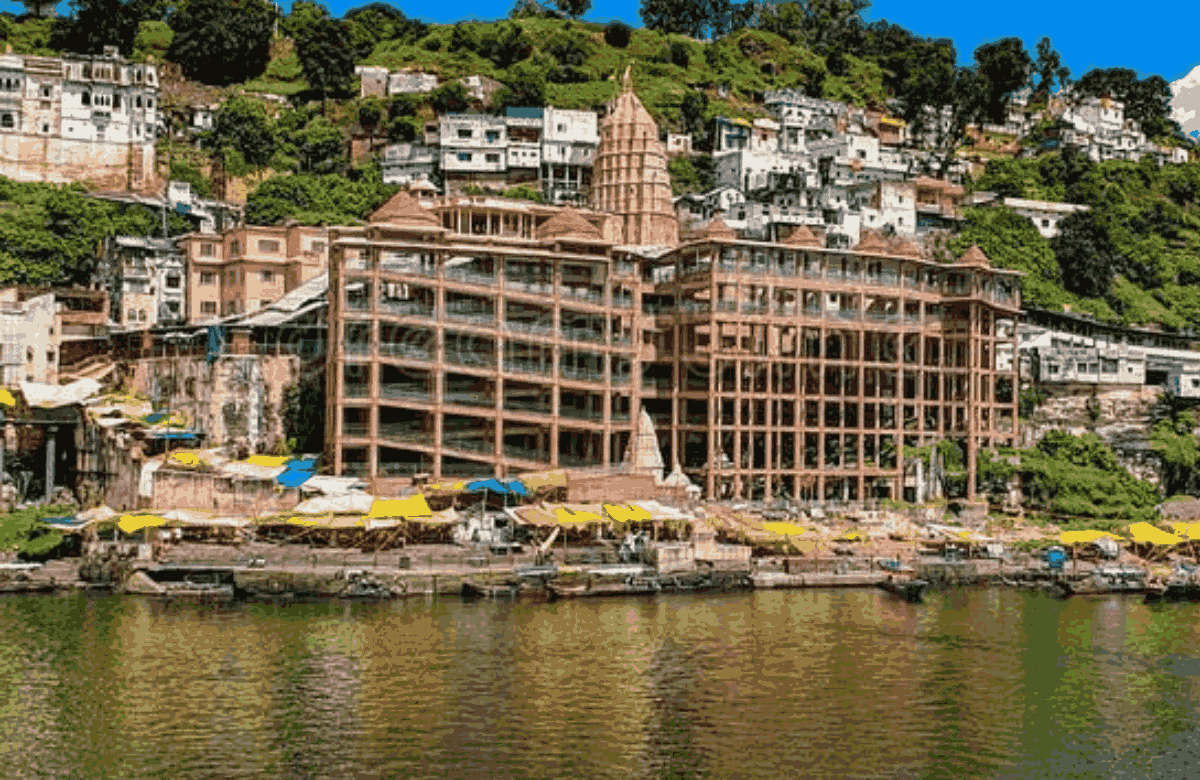
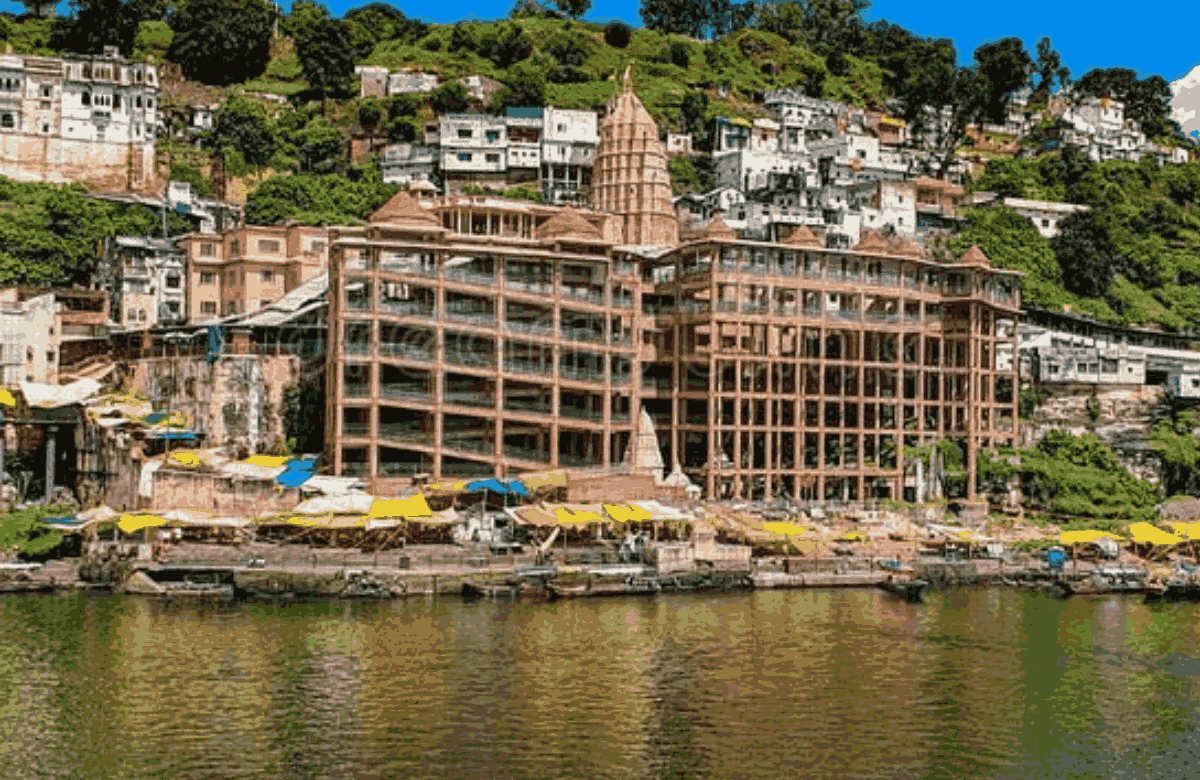
2. Omkareshwar Jyotirlinga, Mandhata Island — The Island Shaped Like Om
Omkareshwar Jyotirlinga holds a unique distinction in the entire geography of Indian pilgrimage: it sits on an island in the Narmada River that is naturally shaped like the sacred syllable Om (■) when viewed from above. This is not a legend — it is a verifiable geographical fact visible in satellite maps and aerial photography. No other Jyotirlinga site carries this specific cosmic symbolism in its physical geography.
Location and Basic Facts
- Location:Location:Location: Island (also called Shivapuri), Narmada River, Khandwa district, Madhya Pradesh
- Distance from Indore: approximately 77 km
- Distance from Ujjain: approximately 140 km (the two MP Jyotirlingas from each other)
- Position in 12 Jyotirlinga sequence: 4th
- The island's natural Om-shape is most clearly visible in Google Earth satellite view
- Temple timings: 5 AM to 10 PM (morning aarti at 5 AM; Shayan Aarti in the evening)
The Extraordinary Feature: One Jyotirlinga, Two Temples
Omkareshwar Jyotirlinga is the only one among the twelve where the single Jyotirlinga is considered to be split across two separate temples. Of the 12 Jyotirlingas, Omkareshwar Jyotirlinga is believed to house a Jyotirlinga that is split between two temples — Omkareshwar and Amareshwar. Omkareshwar means 'Lord of Omkara or the Om sound' and Amareshwar means 'Lord of the Immortal.' At the behest of the gods and sages, Lord Shiva split the linga into two parts — one is at Omkareshwar and the other at Amareshwar or Mamleshwar. Therefore, devotees visit both these temples when they visit Mandhata. This means that pilgrims to Omkareshwar must visit both the main Omkareshwar temple on the island and the Mamleshwar / Amareshwar temple across the river for a complete Jyotirlinga darshan. The pilgrimage is considered incomplete if only one of the two shrines is visited.
The Legend of Omkareshwar
Once, sage Narada told the Vindhya mountain deity that Mount Meru was more important. Feeling challenged, Vindhya performed intense penance to please Lord Shiva. Lord Shiva was pleased with the penance and granted his wish by appearing as a Jyotirlinga there. A second legend tells of King Mandhata of the Ikshvaku dynasty who also performed severe penance here — the island is named after him. The name Omkareshwar derives from 'Omkar' — the primordial sound Om — and 'Ishwar' — Lord. The name 'Omkareshwar' means 'Lord of Omkara' or 'Lord of the Om sound.' A Jyotirlinga represents a 'pillar of light' where Shiva manifested. According to the Shiva Purana and other ancient texts, this is where Mahadev rests after traversing the three worlds daily.
The Shayan Aarti: Omkareshwar's Unique Ritual
Omkareshwar is famous for its Shayan Aarti — a beautiful and unique ritual where Lord Shiva is prepared for rest. Unlike Mahakaleshwar Temple in Ujjain which has Bhasma Aarti, Omkareshwar's specialty is the divine Shayan Aarti. In this evening ritual, the deity is symbolically put to sleep for the night — dressed in night attire and worshipped with a specific sequence of prayers. It is a ceremony of extraordinary intimacy and devotion, unlike the dawn spectacle of Mahakaleshwar.
Architecture and Sacred Structure
The temple has a large prayer hall with about 60 huge and elaborately carved stone pillars supporting it. It is a five-storied structure with each floor having a different deity. Above the Omkareshwar linga is the Mahakaleshwar temple. Sidhnath, Gupteshwar, and Dhwajeshwar temples are on the third, fourth, and fifth floors respectively. The temple also boasts of several lofty spires. One unique feature: the Jyotirlinga isn't directly under the main spire but positioned to the side, which is quite rare!
How to Plan Your Jyotirlinga Yatra in Madhya Pradesh
Both MP Jyotirlingas can be conveniently covered in a single trip using Indore as the base — the city is approximately 55 km from Ujjain and 77 km from Omkareshwar.
Suggested 2-Night, 3-Day Itinerary
- Day 1: Arrive Indore; drive to Omkareshwar (77 km, 1.5 hours); complete darshan at Omkareshwar temple and Mamleshwar/Amareshwar temple; witness the Shayan Aarti in the evening; overnight stay at Omkareshwar or return to Indore
- Day 2: Drive to Ujjain (55 km from Indore, or 140 km from Omkareshwar); attempt Bhasma Aarti at 4 AM — book online in advance; darshan of Mahakaleshwar in the morning; explore Ujjain's other sacred sites (Ram Ghat aarti, Mangalnath, Harsiddhi Mata, Sandipani Ashram)
- Day 3: Return to Indore or continue onward to other Jyotirlinga destinations
How to Reach the Jyotirlingas in Madhya Pradesh
- By air: Devi Ahilyabai Holkar Airport, Indore is the primary gateway — well connected to Delhi, Mumbai, Hyderabad, Bangalore, Chennai, Kolkata
- By train: Ujjain Junction is a major railway station on the Western Railway zone; Omkareshwar Road Station (12 km from the temple) serves Omkareshwar; Khandwa Junction (72 km) is an alternative for Omkareshwar
- By road from Indore to Ujjain: approximately 55 km on NH 52, about 1 to 1.5 hours
- By road from Indore to Omkareshwar: approximately 77 km on NH 52 toward Khandwa, about 1.5 to 2 hours
- Both temples are best reached with personal vehicles or hired taxis from Indore — public buses are available but less convenient for pilgrims with specific aarti timing requirements
Conclusion
Madhya Pradesh is home to two of the most extraordinary Jyotirlingas in all of India — and each offers an experience that is completely unlike the other. Mahakaleshwar gives you the Bhasma Aarti: the most powerful pre-dawn ritual in Hindu practice, at the only south-facing Jyotirlinga, in the ancient city where time was measured from. Omkareshwar gives you the island shaped like Om, a Jyotirlinga split across two rivers, and the intimate poetry of the Shayan Aarti. If you are planning the 12 Jyotirlinga darshan, or simply seeking a pilgrimage that combines history, mythology, and the genuinely extraordinary, Madhya Pradesh rewards the effort completely. Both Jyotirlingas are two hours from Indore. Neither will leave you unchanged.