


- India Travelogue
- Chandan_singh
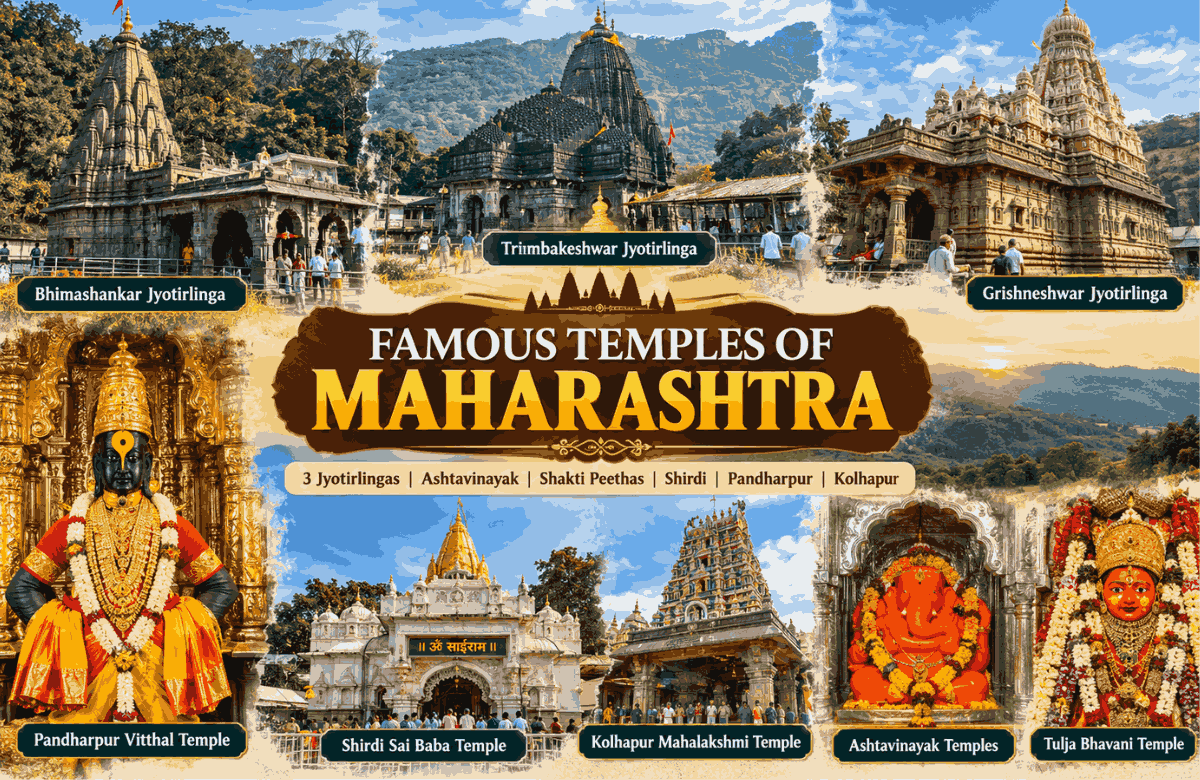
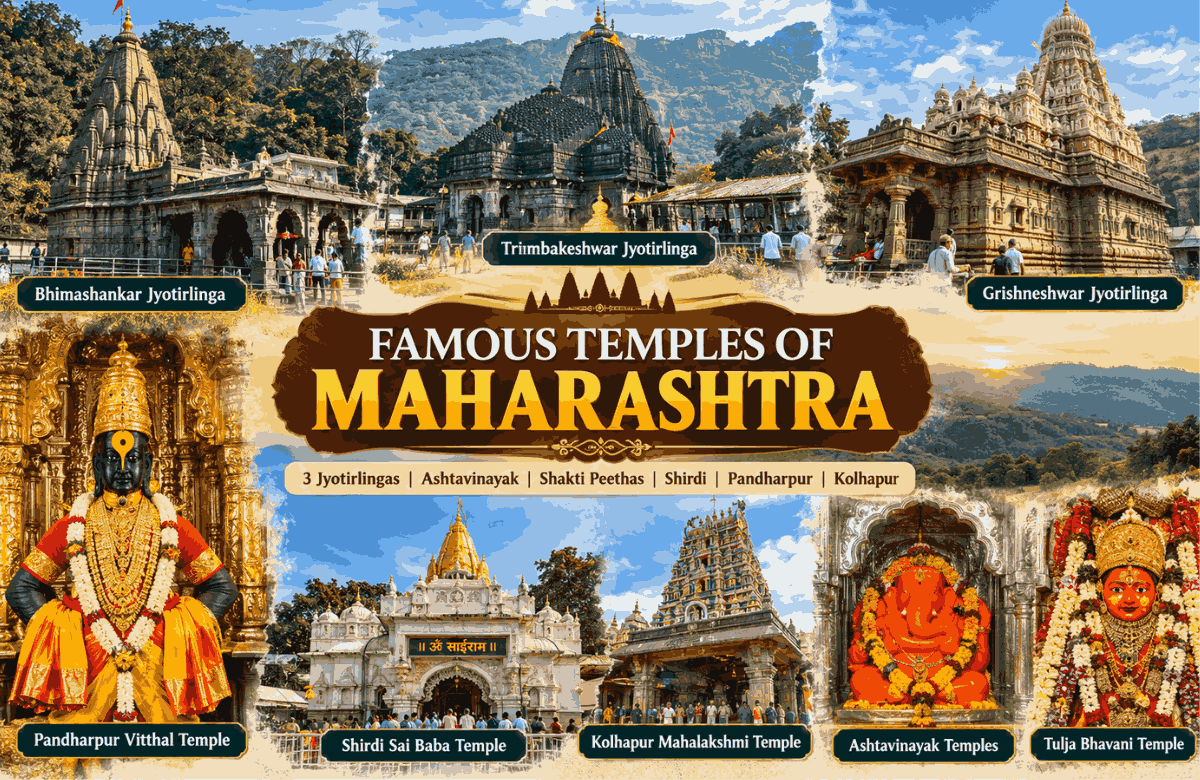
Maharashtra is unlike any other Indian state when it comes to temples. It is home to three Jyotirlingas, eight Ashtavinayak Ganesh temples, famous pilgrimage destinations such as Shirdi, Siddhivinayak, and Pandharpur Vitthal, as well as ancient cave temples, coastal shrines, and sacred sites in the Western Ghats.With so many famous temples in Maharashtra, planning a pilgrimage can be challenging. Which temples should you visit first? What makes each temple special? How can you organise your journey into a practical travel circuit?
This guide covers 25 famous temples of Maharashtra, organised by religious tradition and region, to help pilgrims and travellers understand their significance and plan a meaningful temple tour.

The 3 Jyotirlingas of Maharashtra: Sacred Shiva Temples
Maharashtra is home to three of the twelve traditionally recognised Jyotirlingas of Lord Shiva. Each temple has its own religious history, architecture, and surroundings.
1. Bhimashankar Jyotirlinga
Location: Sahyadri hills, Pune district
Nearest major city: Pune, approximately 110 km away
Bhimashankar Jyotirlinga is a major Shiva pilgrimage destination situated in the Sahyadri hills. Its forested surroundings make it a distinctive destination for both devotees and nature lovers.
Why visit Bhimashankar?
It is traditionally counted as the eighth Jyotirlinga.
The temple is associated with the Bhima River.
The surrounding wildlife sanctuary is known for its rich biodiversity, including the Indian giant squirrel.
The temple features traditional Hemadpanthi-influenced architectural elements.
Its mountain setting makes it especially attractive during the cooler months.
2. Trimbakeshwar Jyotirlinga
Location: Trimbak, Nashik district
Nearest major city: Nashik, approximately 28 km away
Trimbakeshwar Temple is one of Maharashtra's most important Shiva shrines. It is closely associated with the sacred Godavari River and the religious heritage of Nashik.
Why visit Trimbakeshwar?
It is traditionally counted as the sixth Jyotirlinga.
Its distinctive three-faced lingam is associated with Brahma, Vishnu, and Shiva.
The temple is connected with the origin of the Godavari River.
Nashik's Simhastha Kumbh Mela is a major pilgrimage event held on a twelve-year cycle.
3. Grishneshwar Jyotirlinga
Location: Verul, near Ellora, Chhatrapati Sambhajinagar district
Nearest major city: Chhatrapati Sambhajinagar, approximately 29 km away
Grishneshwar Jyotirlinga is traditionally counted as the twelfth and final Jyotirlinga. It is particularly convenient for travellers visiting the famous Ellora Caves.
Why visit Grishneshwar?
It is traditionally recognised as the twelfth Jyotirlinga.
It is approximately 1 km from the Ellora Caves.
The temple is associated with restoration work by Queen Ahilyabai Holkar in the eighteenth century.
Visitors can combine temple darshan with a visit to the UNESCO World Heritage-listed Ellora Caves.
Ashtavinayak: The 8 Sacred Ganesh Temples of Maharashtra
The Ashtavinayak pilgrimage consists of eight sacred temples dedicated to Lord Ganesh. The word Ashtavinayak combines Ashta, meaning eight, and Vinayak, a name for Ganesh.
These temples are located across parts of Maharashtra, particularly in the Pune, Raigad, and neighbouring districts. Traditionally, pilgrims complete the circuit in a clockwise sequence, beginning and ending at Morgaon.
4. Shri Moreshwar (Mayureshwar) Temple
Location: Morgaon, Pune district
Nearest major city: Pune, approximately 65 km away
Moreshwar Temple is traditionally the first and most important stop on the Ashtavinayak circuit.
Why visit?
It is dedicated to Lord Ganesh as Moreshwar or Mayureshwar.
The traditional Ashtavinayak pilgrimage begins and ends here.
The temple is known for its religious importance and traditional architecture.
It is a convenient starting point for pilgrims travelling from Pune.
5. Shri Siddhivinayak Temple, Siddhatek
Location: Siddhatek, Ahmednagar region
Nearest major city: Pune, approximately 100 km away
Siddhivinayak Temple is the second shrine in the traditional Ashtavinayak sequence.
Why visit?
It is dedicated to Siddhivinayak, the form of Ganesh associated with spiritual accomplishment.
The idol is traditionally described as having its trunk turned to the right.
The temple is situated near the Bhima River.
Local religious tradition associates the site with Lord Vishnu's meditation.
6. Shri Ballaleshwar Temple
Location: Pali, Raigad district
Nearest major city: Mumbai, approximately 110 km away
Ballaleshwar Temple is distinctive because it is named after a devotee of Lord Ganesh rather than directly after the deity.
Why visit?
It is the third temple in the traditional Ashtavinayak sequence.
It is associated with the story of the young devotee Ballala.
The temple represents devotion, faith, and perseverance.
7. Shri Varadvinayak Temple
Location: Mahad, Raigad district
Nearest major city: Mumbai, approximately 130 km away
Varadvinayak is worshipped as the form of Lord Ganesh associated with blessings and wishes.
Why visit?
It is the fourth temple in the Ashtavinayak sequence.
The shrine is associated with the tradition of an eternal lamp, known as a nandadip.
It is a popular stop for devotees travelling from Mumbai.
8. Shri Chintamani Temple
Location: Theur, Pune district
Nearest major city: Pune, approximately 25 km away
Chintamani Temple is dedicated to Lord Ganesh as the remover of worries.
Why visit?
It is the fifth temple in the Ashtavinayak sequence.
It has historical associations with Peshwa Madhavrao I.
It is located near the confluence of the Mula and Mutha rivers.
Its proximity to Pune makes it suitable for a shorter temple visit.
9. Shri Girijatmaj Temple
Location: Lenyadri, Pune district
Nearest major city: Pune, approximately 90 km away
Girijatmaj Temple is one of the most distinctive Ashtavinayak shrines because it is situated within a cave complex.
Why visit?
It is the sixth temple in the traditional circuit.
Girijatmaj refers to Ganesh as the son of Girija, or Parvati.
The temple is located within the Lenyadri cave complex.
Visitors must climb approximately 283 steps to reach the shrine.
10. Shri Vighnahar (Vighneshwar) Temple
Location: Ozar, Nashik district region
Nearest major city: Nashik, approximately 85 km away
Vighnahar is worshipped as the remover of obstacles and is the seventh shrine in the traditional Ashtavinayak sequence.
Why visit?
The temple is known for its decorated shikhara.
It is associated with the religious tradition of overcoming obstacles.
Peshwa Chimaji Appa is associated with renovation work at the temple.
11. Shri Mahaganapati Temple
Location: Ranjangaon, Pune district
Nearest major city: Pune, approximately 50 km away
Mahaganapati Temple is the eighth and final shrine in the traditional Ashtavinayak sequence before pilgrims return to Morgaon.
Why visit?
The temple is dedicated to Mahaganapati, the great form of Lord Ganesh.
According to tradition, Lord Shiva worshipped Ganesh here before defeating Tripurasura.
The shrine is an important concluding stop for pilgrims completing the circuit.
Ashtavinayak travel tip: Allow two to three days to complete the circuit by car. Plan your route in advance, check temple timings, and consider the walking and stair-climbing requirements at individual shrines.
Shakti Peethas and Famous Devi Temples of Maharashtra
Maharashtra has several important temples dedicated to the Goddess. These shrines are associated with Shakti worship, regional traditions, and major pilgrimage festivals.
12. Kolhapur Mahalakshmi Temple
Location: Kolhapur, Maharashtra
Kolhapur Mahalakshmi Temple, also known as Ambabai Temple, is one of the state's most prominent Goddess temples.
Why visit?
The temple is dedicated to Goddess Mahalakshmi.
It is traditionally associated with the Shakti Peetha pilgrimage tradition.
The idol faces west, a distinctive feature among major temples.
The Kiranotsav festival, associated with sunlight falling on the deity, is an important annual event.
13. Tulja Bhavani Temple
Location: Tuljapur, Dharashiv district, historically known as Osmanabad
Nearest major city: Solapur, approximately 45 km away
Tulja Bhavani Temple is dedicated to Goddess Bhavani and is deeply connected with Maharashtra's religious and cultural history.
Why visit?
Goddess Tulja Bhavani is revered as the family deity of the Maratha royal family.
The temple is traditionally associated with Chhatrapati Shivaji Maharaj.
It is an important pilgrimage destination, especially during Navratri.
Devotees visit throughout the year to seek the Goddess's blessings.
14. Mahur Renuka Devi Temple
Location: Mahur, Nanded district
Nearest major city: Nanded, approximately 115 km away
Renuka Devi Temple is an important Goddess shrine situated in a scenic hill region.
Why visit?
Goddess Renuka is worshipped here.
The temple is connected with the story of Parashurama and his mother, Renuka.
The shrine is significant for devotees from Maharashtra and Karnataka.
Its hilltop setting adds to the pilgrimage experience.
15. Saptashringi Devi Temple
Location: Nashik district, Maharashtra
Nearest major city: Nashik, approximately 75 km away
Saptashringi Devi Temple is situated in the Sahyadri hills and is known for its dramatic natural setting.
Why visit?
The Goddess is traditionally depicted with eighteen arms.
The temple is associated with a mountain range described as having seven peaks.
The natural rock formation and surrounding hills make the site distinctive.
It is an important destination during Navratri.
Famous Vaishnava and Sant Sampradaya Temples
Maharashtra's devotional heritage is strongly shaped by the Warkari tradition, centred on Lord Vitthal of Pandharpur, and the teachings of its poet-saints.
16. Pandharpur Vitthal Temple
Location: Pandharpur, Solapur district
Nearest major city: Solapur, approximately 75 km away
Pandharpur Vitthal Temple is one of Maharashtra's most beloved pilgrimage destinations. Lord Vitthal, also known as Vithoba or Pandurang, is worshipped here as a form of Lord Vishnu.
Why visit?
The temple is central to the Warkari devotional movement.
The deity is traditionally depicted standing on a brick with hands resting on the hips.
Large numbers of devotees participate in the Wari pilgrimage during Ashadhi and Kartiki Ekadashi.
The temple is associated with the devotional poetry of Dnyaneshwar, Namdev, Tukaram, and Eknath.
17. Shirdi Sai Baba Temple
Location: Shirdi, Maharashtra
Shirdi Sai Baba Temple is one of India's best-known pilgrimage destinations and attracts devotees from different religious backgrounds.
Why visit?
Sai Baba is revered for teachings associated with faith, patience, compassion, and service.
The temple complex includes the Samadhi Mandir and Dwarkamai.
The shrine attracts visitors throughout the year.
Shirdi can be combined with other temple destinations in the Nashik region.
Travel tip: Check current darshan schedules and crowd-management arrangements before your visit, especially during festivals.
18. Alandi Dnyaneshwar Temple
Location: Alandi, Pune district
Nearest major city: Pune, approximately 25 km away
Alandi is an important pilgrimage centre associated with Sant Dnyaneshwar, the thirteenth-century Marathi poet-saint.
Why visit?
Sant Dnyaneshwar is remembered for his commentary on the Bhagavad Gita, known as the Dnyaneshwari.
The site is associated with his Sanjeevan Samadhi.
Alandi is an important starting point for Warkari pilgrimage processions to Pandharpur.
The temple town has a deep connection with Marathi devotional literature.
19. Dehu Tukaram Maharaj Temple
Location: Dehu, Pune district
Nearest major city: Pune, approximately 25 km away
Dehu is closely associated with Sant Tukaram Maharaj, one of Maharashtra's most influential poet-saints.
Why visit?
The site commemorates Sant Tukaram's life and devotional teachings.
His Abhanga compositions remain an important part of Marathi spiritual culture.
The temple is associated with the Warkari pilgrimage tradition.
A palkhi procession connected with Sant Tukaram departs from Dehu during the pilgrimage season.
20. Akkalkot Swami Samarth Temple
Location: Akkalkot, Solapur district
Nearest major city: Solapur, approximately 30 km away
Akkalkot is a major pilgrimage destination associated with Swami Samarth, a saint revered by devotees of Lord Dattatreya.
Why visit?
Swami Samarth is regarded by devotees as a manifestation of Lord Dattatreya.
The temple attracts pilgrims from Maharashtra, Karnataka, and Andhra Pradesh.
Akkalkot can be combined with Pandharpur and other pilgrimage destinations in the Solapur region.
Famous Temples of Mumbai and Urban Maharashtra
Mumbai and other urban centres in Maharashtra have important temples that are accessible to travellers planning shorter visits or city-based pilgrimage trips.
21. Siddhivinayak Temple, Mumbai
Location: Prabhadevi, Mumbai
Nearest railway station: Dadar, approximately 1 km away
Siddhivinayak Temple is one of Mumbai's best-known temples dedicated to Lord Ganesh.
Why visit?
The temple is associated with Siddhivinayak, the form of Ganesh worshipped for blessings and the removal of obstacles.
The idol is known for its right-facing trunk.
The temple attracts devotees from across India.
Many visitors seek blessings before important personal and professional milestones.
22. Mahalakshmi Temple, Mumbai
Location: Mahalaxmi, Mumbai
Nearest railway station: Mahalaxmi, approximately 0.5 km away
Mahalakshmi Temple is one of Mumbai's prominent Goddess temples, situated near the Arabian Sea.
Why visit?
The temple houses Mahalakshmi, Mahakali, and Mahasaraswati.
It is associated with Mumbai's religious history.
Navratri is an important festival period at the temple.
Its coastal setting makes it a distinctive stop on a Mumbai temple tour.
23. Khandoba Temple, Jejuri
Location: Jejuri, Pune district
Nearest major city: Pune, approximately 50 km away
Jejuri is an important pilgrimage destination dedicated to Lord Khandoba, a deity widely worshipped in Maharashtra.
Why visit?
Khandoba is revered as a family deity by many Maharashtrian communities.
The temple is famous for the tradition of offering bhandara, or turmeric powder.
During festivals, turmeric gives the temple complex its distinctive golden appearance.
Jejuri can be combined with other temples near Pune.
24. Vajreshwari Temple
Location: Vajreshwari, Thane district
Nearest major city: Mumbai, approximately 90 km away
Vajreshwari Temple is dedicated to Goddess Vajreshwari and is an important pilgrimage destination in the Mumbai Metropolitan Region.
Why visit?
The temple is associated with regional Goddess worship.
Natural hot springs are located nearby.
It can be combined with a visit to Ganeshpuri and other pilgrimage destinations in Thane district.
25. Kalaram Temple, Nashik
Location: Panchavati, Nashik
Kalaram Temple is a major temple dedicated to Lord Rama and is known for its black stone idol.
Why visit?
The temple is an important religious landmark in Panchavati.
The black stone image of Lord Rama gives the temple its name.
The temple is associated with the historic Kalaram Temple Entry Satyagraha led by Dr. B. R. Ambedkar in 1930.
It can be combined with visits to Ram Kund, Sita Gufa, and other religious sites in Nashik.
Maharashtra Temple Circuits: How to Plan Your Pilgrimage
Maharashtra's temples are spread across different regions, but many can be grouped into practical travel circuits. Planning by region can reduce unnecessary driving and make your journey more comfortable.
Circuit 1: Pune-Based Temple Circuit (2–3 Days)
This circuit combines Ashtavinayak temples with other important religious sites around Pune.
Day 1
Chintamani Temple, Theur.
Moreshwar Temple, Morgaon.
Siddhivinayak Temple, Siddhatek, subject to travel time.
Day 2
Mahaganapati Temple, Ranjangaon.
Girijatmaj Temple, Lenyadri.
Vighnahar Temple, Ozar.
Alandi Dnyaneshwar Temple, if time permits.
Day 3
Bhimashankar Jyotirlinga.
Khandoba Temple, Jejuri.
Dehu Tukaram Maharaj Temple, depending on your route.
This is an ambitious itinerary. Adjust the stops according to temple timings, road conditions, and your starting point.
Best Time to Visit Famous Temples of Maharashtra
Maharashtra's temples can generally be visited throughout the year. However, weather, religious festivals, and local events can affect the experience.
October to March: Best Overall Season
This period generally offers comfortable weather for travel, particularly in the Sahyadri hills and other outdoor pilgrimage areas. It is a good time for sightseeing and multi-day temple circuits, except during major festivals when crowds may increase.
Ganesh Chaturthi: August or September
Ganesh Chaturthi is one of Maharashtra's most important festivals. Ashtavinayak temples and Siddhivinayak Temple can experience very heavy crowds during this period. Book accommodation and transport in advance and expect longer queues.
Navratri: September or October
Navratri is an important festival at Goddess temples, including Kolhapur Mahalakshmi, Tulja Bhavani, Renuka Devi, and Saptashringi Devi. Special rituals and celebrations may take place, but visitor numbers can rise considerably.
Ashadhi and Kartiki Ekadashi
These two important Warkari pilgrimage occasions bring large numbers of devotees to Pandharpur. The palkhi processions associated with Alandi and Dehu are major highlights of Maharashtra's devotional culture.
Mahashivratri: February or March
Mahashivratri is an important festival at Shiva temples, including Bhimashankar, Trimbakeshwar, and Grishneshwar. Expect special religious programmes and substantial crowds.
Practical Travel Tips for Visiting Maharashtra Temples
Check temple timings: Opening hours, aarti schedules, and special darshan rules may change during festivals.
Book accommodation early: Popular destinations such as Shirdi, Pandharpur, and Kolhapur can become crowded during major religious occasions.
Plan realistic driving distances: Avoid trying to visit too many temples in one day.
Wear appropriate clothing: Follow the dress guidelines of each temple.
Carry essential medicines and water: This is especially important for long journeys and hill temples.
Prepare for stairs: Some temples, including Girijatmaj at Lenyadri, require significant climbing.
Use official booking channels: Check official temple websites or trust offices for special darshan and pooja bookings.
Allow extra time for queues: Festival periods may involve long waiting times.
Respect local customs: Follow photography restrictions, footwear rules, and other temple instructions.
Final Thoughts: Maharashtra, a Land of Sacred Traditions
Maharashtra brings together a remarkable range of spiritual traditions. The forest setting of Bhimashankar, the sacred history of Trimbakeshwar, the heritage of Grishneshwar, the eight Ashtavinayak shrines, the devotion of Pandharpur, and the enduring appeal of Shirdi offer very different pilgrimage experiences. You can begin with the Ashtavinayak circuit if you are a Ganesh devotee, visit the three Jyotirlingas if your focus is Lord Shiva, or follow the Warkari path to Pandharpur to experience Maharashtra's devotional heritage. The best temple journey is not simply about visiting as many places as possible. It is about allowing enough time for worship, learning the traditions associated with each shrine, and travelling with respect for local customs.
Plan your route carefully, confirm current timings, and leave room for unexpected discoveries along the way.
Har Har Mahadev! Ganpati Bappa Morya!