

- India Travelogue
- Chandan_singh
You type "jyotirlinga in Gujarat" into a search bar, and the answers pull in four directions. One page says two. Another lists three. A third buries Gujarat inside a giant table of twelve temples. Then you open the timings: one site says the temple shuts at 9:30 PM, while another says 10 PM. Nobody tells you that the two shrines sit about 250 km apart or that the drive takes most of a day.
This guide fixes that. It gives you a clear Gujarat Jyotirlinga list, the story behind each shrine, typical darshan and aarti timings, practical travel information, and a four-day itinerary you can follow. It is written for the person who wants to make the pilgrimage, not just read about it.Gujarat is the state where you can visit Somnath, traditionally counted as the first of the twelve Jyotirlingas, and Nageshwar on the same coastal trip. Both are associated with the Arabian Sea coastline and are accessible from Dwarka, one of the Char Dham pilgrimage destinations.
Quick Answer:How Many Jyotirlingas Are in Gujarat?
Gujarat has 2 Jyotirlingas:
Somnath Jyotirlinga — Prabhas Patan, Gir Somnath district.
Nageshwar Jyotirlinga — Daarukavanam, near Dwarka in Devbhumi Dwarka district.
Somnath is traditionally counted as the first of the twelve Jyotirlingas in India. According to temple tradition, Nageshwar is associated with protection from poison.
Jyotirlinga in Gujarat List: Somnath and Nageshwar
Here is a practical comparison of the two Jyotirlingas in Gujarat.
| Detail | Somnath Jyotirlinga | Nageshwar Jyotirlinga |
|---|---|---|
| Location | Prabhas Patan, near Veraval | Daarukavanam, near Dwarka |
| District | Gir Somnath | Devbhumi Dwarka |
| Traditional order | First | Eighth in the traditional list |
| Religious association | Lord of the Moon | Lord of the Serpents; protection from poison |
| Nearest railway station | Veraval | Dwarka |
| Airport options | Keshod, Diu and Rajkot | Jamnagar and Porbandar |
| General darshan | Free | Free |
| Suggested time | 3–4 hours, including the evening show | 30–45 minutes for darshan; longer if visiting nearby attractions |
Airport and railway information is intended to help with trip planning. Neither temple has an airport directly at the shrine, so the final stretch must be completed by road.
How Many Jyotirlingas Are in Gujarat? Settling the Confusion
The short answer is two. The longer answer explains why some websites give different numbers.
Why Some Websites Say One or Three
Websites that list only one Jyotirlinga often focus exclusively on Somnath because it is Gujarat's best-known Shiva shrine. Websites that list three may include other sacred Shiva temples in Gujarat, such as Bhadkeshwar Mahadev near Dwarka or Koteshwar in Kutch. These are important religious sites, but they are not generally counted among the twelve Jyotirlingas.
The Nageshwar Debate: Gujarat or Maharashtra?
The Dwadasha Jyotirlinga Stotram refers to Nageshwar in connection with "Daruka Vana." Different places have been associated with this reference, including:
Nageshwar Temple near Dwarka in Gujarat.
Aundha Nagnath in Maharashtra.
Jageshwar in Uttarakhand.
Most pilgrimage guides and tour operators include the Nageshwar temple near Dwarka in the Gujarat Jyotirlinga circuit. This guide follows that commonly used itinerary.
If you are undertaking the pilgrimage according to a particular family or religious tradition, consult your family priest about the shrine associated with that tradition.
Somnath Jyotirlinga: The First Gujarat Jyotirlinga Temple
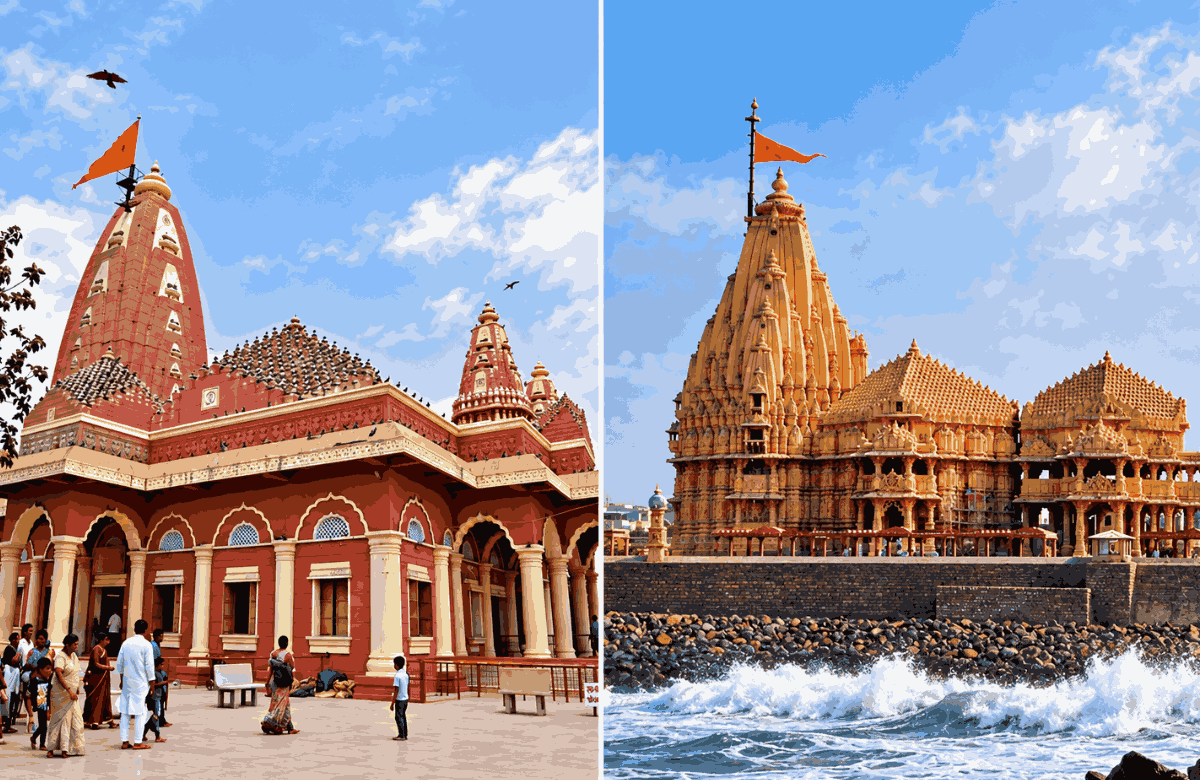
Somnath is the temple most people mean when they refer to the Gujarat Jyotirlinga. It stands at Prabhas Patan on the Arabian Sea coast, close to Veraval. The sound of the sea adds to the atmosphere during evening aarti. Somnath is also one of India's most historically significant Shiva temples.

Location of Somnath Temple
Somnath Temple is located in Prabhas Patan, in the Gir Somnath district of Gujarat's Saurashtra region. Veraval railway station is the nearest major railway access point, followed by a short road journey to the temple. Travellers with additional time may also consider visiting Gir National Park, which is famous for the Asiatic lion. Check safari availability and seasonal restrictions before planning a visit.
The Legend: Why the Moon Built Somnath
According to Hindu tradition, Chandra, the Moon god, married the 27 daughters of Daksha but favoured Rohini above the others. Daksha became displeased and cursed Chandra to lose his radiance. Chandra came to Prabhas Patan and worshipped Lord Shiva with great devotion. Shiva then alleviated the curse. The story is traditionally associated with the waxing and waning of the Moon. Chandra is also said to have built the original golden temple here in gratitude.
The name Somnath means "Lord of the Moon."
Somnath Temple History: Destroyed and Rebuilt
Somnath is a symbol of religious continuity and rebuilding. The temple faced repeated attacks and destruction throughout its history, followed by reconstruction. A major recorded attack took place in January 1026. In later centuries, rulers and devotees continued to rebuild the shrine. In the eighteenth century, Ahilyabai Holkar constructed a smaller temple nearby. The present temple was reconstructed and reopened on 11 May 1951.
In 2026, two historical milestones were marked: 1,000 years since the 1026 attack and 75 years since the reopening in 1951. The temple's history gives the pilgrimage a significance that extends beyond architecture. For many devotees, Somnath represents faith, resilience and the continuity of worship.
Architecture of Somnath Temple
Somnath combines traditional Indian temple architecture with a dramatic coastal setting.
Architectural style: Chalukyan-influenced temple design.
Shikhara: Approximately 50 metres tall.
Baan Stambh: The Arrow Pillar near the seafront, associated with a famous inscription describing the uninterrupted oceanic direction towards the South Pole.
Location: The temple faces the sea, making early mornings and sunsets particularly appealing for visitors.
Somnath Temple Timings and Aarti Schedule
The following timings are approximate planning information. Confirm the schedule with the temple trust before travelling.
| Service | Typical Timing | Notes |
|---|---|---|
| Temple darshan | 6 AM–9:30/10 PM | Published timings may differ |
| Mangala Aarti | 7 AM | Morning worship |
| Rajbhog Aarti | 12 PM | Midday worship |
| Sandhya Aarti | 7 PM | Evening worship; arrive early |
| Light and sound show | Evening, approximately 8–9 PM | Timing and availability can change |
| Optional VIP darshan | During designated hours | Check current availability and fees |
Festival days may bring changes to opening hours and crowd-management arrangements. During Mahashivratri, Shravan and the Kartik Purnima fair, queues may be considerably longer.
Jay Somnath: The Light and Sound Show
The Somnath light and sound show presents the temple's history through narration, lighting and the natural sound of the sea. The show tells the story of Somnath, from the legend of Chandra to the temple's repeated destruction and reconstruction. If you have one evening in Somnath, consider attending the evening aarti and then the show, provided both are operating that day. Check the current schedule and ticket requirements locally. Heavy rain or other operational reasons may affect the programme.
What to See Near Somnath
Triveni Sangam
Triveni Sangam is associated with the meeting of the Hiran, Kapila and Saraswati rivers. Pilgrims visit the area for religious observances and ritual bathing.
Bhalka Tirth
Bhalka Tirth is traditionally associated with the final earthly moments of Lord Krishna, who is believed to have been struck by an arrow at this location.
Somnath Beach
Somnath Beach offers a place to relax and enjoy the coastal setting after darshan. Follow local safety instructions and avoid entering rough waters.
Gir National Park
If you have an additional day, consider a safari in Gir National Park. It is known for the Asiatic lion. Safari permits, availability and seasonal closures should be checked in advance.
Prabhas Patan Museum
The museum is worth considering for travellers interested in the history of Somnath and the architectural remains associated with earlier versions of the temple.
Nageshwar Jyotirlinga: The Second Gujarat Shiva Temple
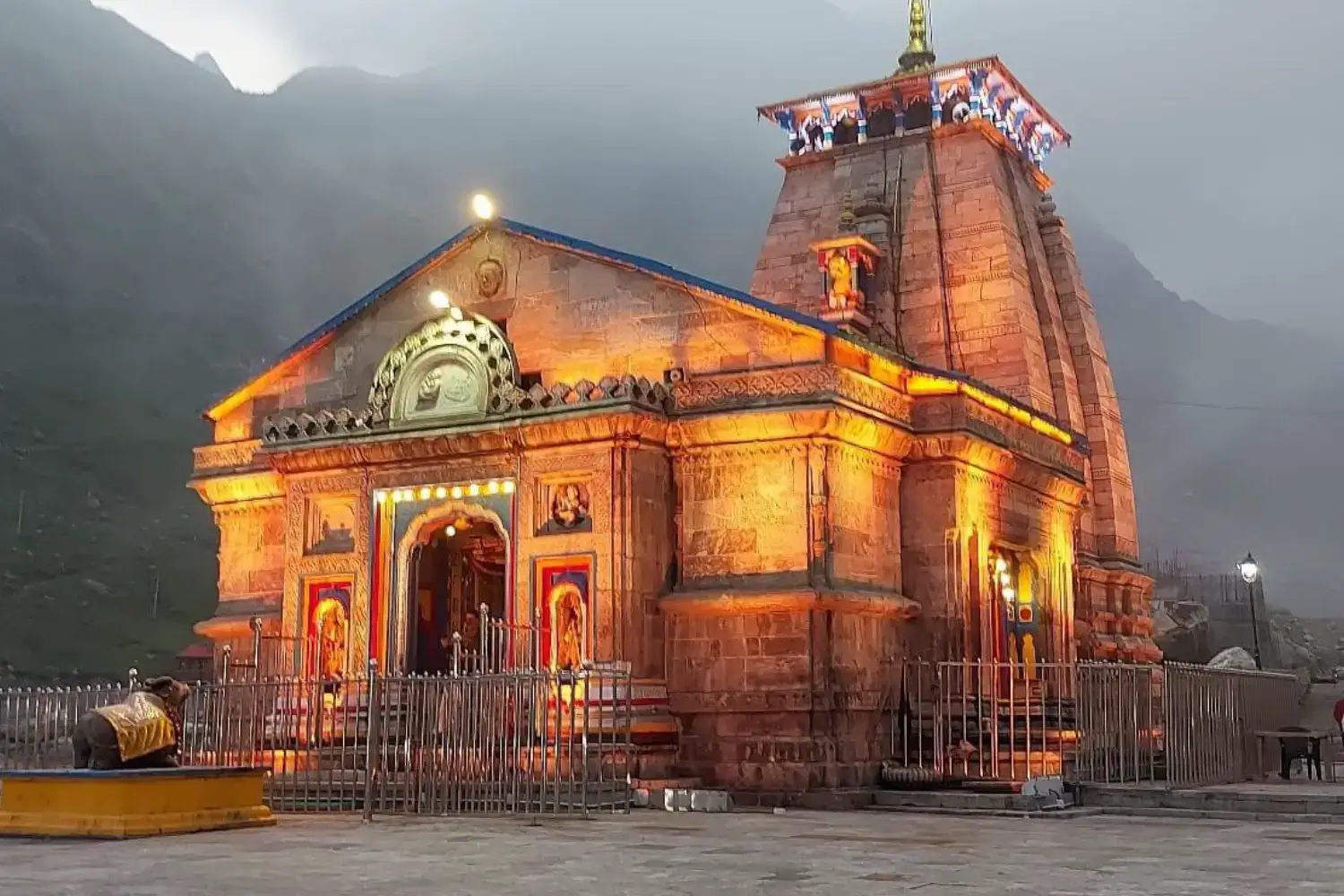
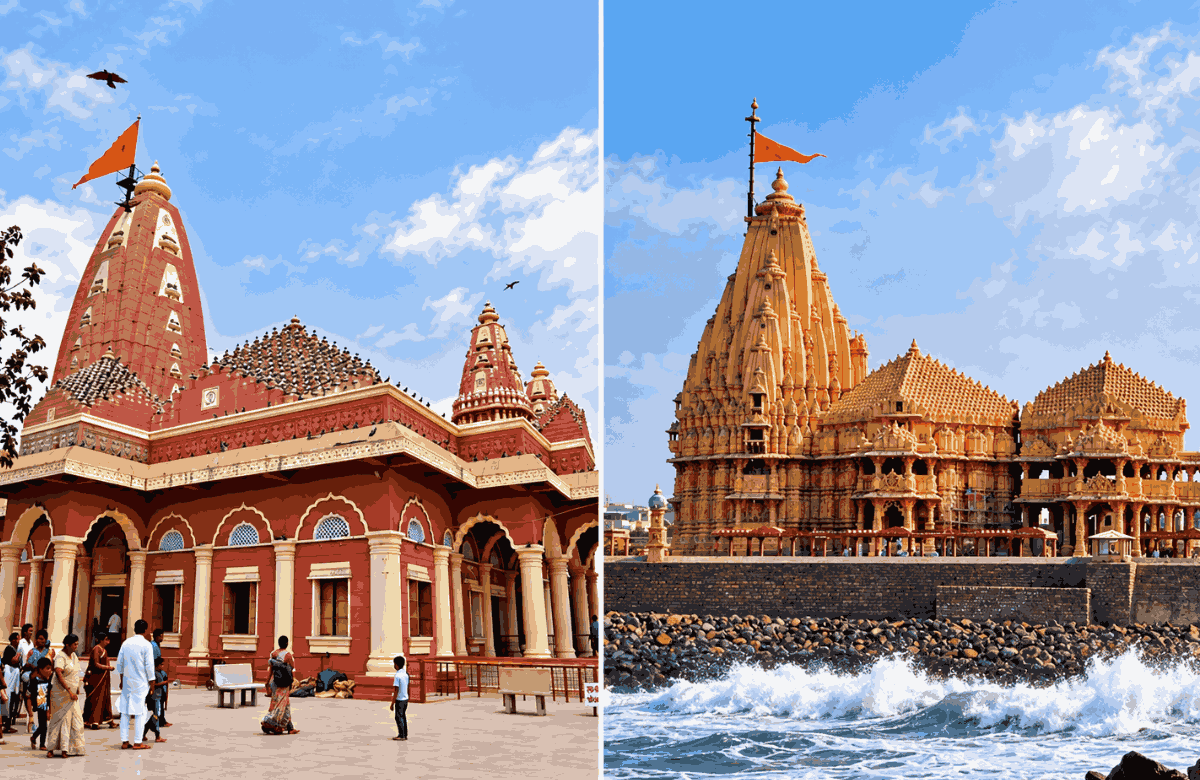
If Somnath is grand and historically prominent, Nageshwar offers a different atmosphere. The temple stands in the area traditionally associated with Daruka Vana, now called Daarukavanam, along the road between Dwarka and Beyt Dwarka.

A large seated statue of Lord Shiva is visible from the highway as visitors approach the temple.
Location of Nageshwar Temple
Nageshwar Temple is approximately 15–18 km from Dwarka, depending on the route. Taxis and shared transport may be available along the Beyt Dwarka road. The temple is located in the Devbhumi Dwarka district of Gujarat. Because of its proximity to Dwarkadhish Temple, many pilgrims visit Nageshwar and Dwarka on the same day.
The Legend of Nageshwar
The Shiva Purana tells the story of a devoted merchant named Supriya, who was imprisoned by a demon named Daruka in the forest of Daruka Vana. Even while imprisoned, Supriya continued chanting Lord Shiva's name and encouraged fellow captives to do the same. Lord Shiva appeared in the form of a Jyotirlinga, overcame the demon's power and freed the captives.
According to temple tradition, Nageshwar is associated with protection from poison and harm. Many devotees visit to pray for protection, peace and well-being.
Nageshwar Temple Timings
| Detail | Typical Information | Notes |
|---|---|---|
| Morning darshan | Approximately 6 AM–12:30 PM | Confirm locally |
| Evening darshan | Approximately 5 PM–9:30 PM | Afternoon break may apply |
| General entry | Free | Optional services may have separate charges |
| Time required | 30–45 minutes | Allow additional time for crowds and nearby attractions |
Published timings vary, and the temple trust may change the schedule during festivals. Verify the timings before setting out from Dwarka.
What to See at and Around Nageshwar
The Giant Shiva Statue
The large seated statue of Lord Shiva is one of the temple's most recognisable landmarks and a popular photography spot.
The Temple Sanctum
The sanctum is the central place of worship. Allow time for queues and follow the temple's rules for darshan.
Dwarkadhish Temple
Dwarkadhish Temple is the principal Krishna temple in Dwarka and an important destination on the Char Dham and Sapta Puri pilgrimage circuits.
Rukmini Devi Temple
Located a short drive from Dwarka, Rukmini Devi Temple is known for its stonework and religious significance.
Beyt Dwarka
Beyt Dwarka is an island associated with Lord Krishna. Visitors can plan a boat journey when services are operating and weather conditions permit.
Gomti Ghat
Gomti Ghat, in Dwarka town, is a riverside pilgrimage area. Early morning can be a peaceful time to visit, depending on local conditions.
Somnath vs Nageshwar: Which Gujarat Jyotirlinga Should You Visit First?
Both temples are important, but the experience at each is different.
| Factor | Somnath | Nageshwar |
|---|---|---|
| Atmosphere | Grand, busy and well-organised | Smaller and devotional |
| Religious story | The Moon's redemption and the temple's rebuilding | Supriya's devotion and protection from poison |
| Crowd levels | High on weekends and festivals | Generally lighter, except during major festivals |
| Best experience | Evening aarti and the light and sound show | Early morning darshan followed by Dwarka sightseeing |
| Nearby attractions | Triveni Sangam, Bhalka Tirth and Gir | Dwarkadhish Temple, Beyt Dwarka and Rukmini Devi Temple |
| Accessibility | Road access and visitor facilities | Short road journey from Dwarka |
Our recommendation: Start with Somnath, traditionally counted first in the Dwadasha Jyotirlinga list. Continue to Nageshwar and Dwarka to complete the coastal pilgrimage.
How to Reach the Gujarat Jyotirlinga Temples
Both temples are accessible by road, rail and air connections through nearby cities. The main planning challenge is linking the two locations efficiently.
Somnath and Nageshwar are approximately 250 km apart by road, and the journey generally takes around 4–5 hours without long stops.
By Air
For Somnath: Keshod is one airport option, with Diu and Rajkot also worth considering. The remaining journey must be completed by road.
For Nageshwar and Dwarka: Jamnagar is a common airport option, approximately 130 km away. Porbandar may also be considered, at roughly 100 km.
From Ahmedabad: Travellers may fly into Ahmedabad and continue by train or road, depending on their budget and schedule.
Compare flight availability and total journey time before choosing an airport.
By Train
Somnath: Travel to Veraval railway station and continue by auto or taxi.
Nageshwar: Travel to Dwarka railway station and continue approximately 15–18 km by road.
Booking tip: Trains may fill up early during Shravan, Navratri and busy winter weekends. Book through IRCTC well in advance.
By Road
Ahmedabad to Somnath: Approximately 400 km, around 7–8 hours.
Rajkot to Somnath: Approximately 200 km, around 4 hours.
Somnath to Dwarka/Nageshwar: Approximately 250 km, around 4–5 hours.
Self-drive, private cabs and state bus services are possible options. Allow additional time for traffic, meals and breaks.
Best Time to Visit Gujarat Jyotirlinga Temples
The best time depends on whether you prioritise comfortable weather or festival experiences.
Winter: October to March
Winter is generally the most comfortable season for visiting both temples. Daytime temperatures are often around 15°C–32°C, although actual conditions vary.
Carry light clothing for the day and a shawl for cooler evenings.
Shravan: July to August
Shravan is especially significant for Shiva devotees. The temples may be decorated, and religious activity increases.
Expect longer queues, more visitors and potentially higher accommodation prices. Book transport and hotels in advance.
Mahashivratri: February to March
Mahashivratri is one of the most important occasions for Shiva worship. Special night-long prayers and religious ceremonies may take place.
The experience can be spiritually rewarding but is generally much busier than an ordinary visit.
Summer: April to June
Summer can be hot and humid. Plan outdoor sightseeing for early morning or late afternoon, carry water and take breaks.
Monsoon: June to September
The monsoon brings greenery to the region, but heavy rain can affect road journeys and outdoor activities. The Somnath light and sound show may be suspended during heavy rain.
Check weather forecasts and local updates before travelling.
Practical Tips for Your Gujarat Jyotirlinga Trip
Travel light: Temple security may restrict bags, mobile phones and cameras in designated areas. Follow the current rules and use available storage facilities where necessary.
Dress modestly: Choose respectful, comfortable clothing and follow the temple's dress guidelines.
Book accommodation early: Somnath and Dwarka can become crowded during festivals. Trust-run dharamshalas may be budget-friendly options.
Verify temple timings: Published schedules can differ. Confirm darshan and aarti timings with the temple trust before visiting.
Allow extra driving time: The Somnath-to-Dwarka journey can take longer because of traffic, road conditions and stops.
Carry some cash: Small shops and offerings may be easier to manage with cash, although UPI is widely accepted in many places.
Use official booking channels: For online pooja services, verify that you are using the official temple trust website rather than an unverified third-party seller.
Plan for elderly pilgrims: Ask temple staff about wheelchair assistance or other available facilities. Queues may still be long.
Respect the sea: Avoid swimming in rough waters at Somnath Beach and Beyt Dwarka. Follow local safety instructions.
Final Thoughts: Two Shrines, One Coast, One Shiva
A Gujarat Jyotirlinga pilgrimage is more than a journey between two temples. Somnath represents the endurance of faith through centuries of change and rebuilding. Nageshwar offers a different experience, rooted in devotion and the traditional belief in divine protection.Begin with Somnath for the evening aarti and, if available, the light and sound show. Travel to Dwarka the next day, then reach Nageshwar early to make the most of your visit before the heat and crowds build.
Bring patience, comfortable shoes and an open heart. Give yourself enough time for darshan, travel and the smaller sacred places along the way.
Har Har Mahadev!