

- Amarnath Yatra
- @nagarjuna_travels
Here is the problem that trips up almost every first-time Amarnath yatri. You search for the walking distance and you get a number — say, 36 km from Pahalgam, or 14 km from Baltal. And then you search again and get a different number. Then you find a third number that is different again. By the time you are done, you have three conflicting figures in your head and no clear picture of what the walk actually involves. The confusion comes from the fact that different sources count different sections. Some count from the base camp. Some count from intermediate points like Chandanwari. Some include only the trek and leave out the road section entirely. This guide gives you the exact amarnath yatra walking distance from every relevant starting point — Pahalgam, Baltal, Chandanwari, Jammu, Katra, and Kashmir. Every number is broken down stage by stage so you know not just the total distance but what each kilometre actually looks like on the ground: the altitude, the terrain, the time, and what to expect when you get there. Read this once and the distance question is settled.
Amarnath Yatra Walking Distance: The Direct Answer
Before we go into the detail of every stage and every starting point, here is the direct answer to the core question. The amarnath yatra walking distance depends on which route you take and where you begin counting.From Pahalgam — the traditional base camp — the walking distance to the Holy Cave is 36 to 48 km one way. The variation in that number comes from which sub-route you take through the Pahalgam approach. The most common route via Chandanwari, Sheshnag, and Panjtarni covers approximately 36 km. The longer traditional route adds additional stages and can reach 48 km. The amarnath yatra walking distance from Pahalgam round trip — going up and coming back down the same route — is therefore approximately 72 to 96 km over three to four days. From Baltal — the shorter base camp — the amarnath yatra walking distance from Baltal is approximately 14 to 16 km one way. The round trip from Baltal is approximately 28 to 32 km, typically completed in a single very long and demanding day. Both routes reach the same Holy Cave at 3,888 m. The walking distance is different. The experience is different. The destination is identical.
Amarnath Yatra Walking Distance: Complete Reference Table
This table captures the amarnath yatra walking distance from every key starting point — from the base camps to the cave, from Jammu and Katra to the trailhead, and every major stage in between. Use this as your master reference when planning.
| Starting Point | Destination | Distance | Mode | Approx. Time |
| Pahalgam / Nunwan | Holy Cave | 36–48 km | On foot | 3–4 days |
| Chandanwari | Holy Cave | ~20–22 km | On foot | 2 days |
| Baltal | Holy Cave | 14–16 km | On foot | 1 day |
| Panjtarni | Holy Cave | ~6 km | On foot / pony | 2–3 hrs |
| Srinagar | Pahalgam Base Camp | ~96 km | Road | 2.5–3 hrs |
| Srinagar | Baltal Base Camp | ~93 km | Road | 2–2.5 hrs |
| Jammu Tawi | Pahalgam Base Camp | ~315 km | Road | 6–7 hrs |
| Jammu Tawi | Baltal Base Camp | ~330 km | Road | 8–9 hrs |
| Katra | Pahalgam Base Camp | ~360 km | Road | 7–8 hrs |
Amarnath Yatra Walking Distance from Pahalgam: Stage by Stage
The amarnath yatra walking distance from pahalgam is the number most pilgrims search for because Pahalgam is the traditional starting point — the route walked by saints, sages, and millions of devotees for centuries. The trek begins at Nunwan base camp, just outside Pahalgam town at 2,130 m, and climbs to the Holy Cave at 3,888 m — a total altitude gain of 1,758 metres spread across four stages over three to four days.
Stage 1 — Pahalgam to Chandanwari: 16 km
The pahalgam to amarnath distance by foot begins with this first stage — a 16 km walk from Nunwan camp along the Lidder River valley to Chandanwari at 2,895 m. This is the most approachable stage of the pahalgam to amarnath trek distance. The trail is wide, well-marked, and graded gently for the first half before the terrain becomes rockier and more demanding as you approach Chandanwari. Average walking time is 5 to 6 hours. Ponies are available throughout this stage. Chandanwari has tent accommodation, food stalls, and medical facilities. Early in the yatra season, a natural snow bridge across the Lidder River at Chandanwari is one of the most memorable sights of the entire trek.
Stage 2 — Chandanwari to Sheshnag: 13 km
This stage covers the chandanwari to amarnath distance by foot — or more precisely, the distance from Chandanwari toward the cave, passing through the Pisu Ghati ridge and arriving at Sheshnag Lake at 3,590 m. The 13 km from Chandanwari to Sheshnag is the most scenically dramatic section of the Pahalgam route and also the most physically demanding up to this point. The Pisu Ghati climb is steep and sustained. The reward at the top — a panoramic view of the surrounding Himalayan peaks — is worth every step. The arrival at Sheshnag Lake, a deep glacial blue at 3,590 m, is one of the defining experiences of the amarnath yatra. Walking time is 5 to 6 hours. Accommodation at Sheshnag is in fixed-camp tents.
Stage 3 — Sheshnag to Panjtarni: 12 km
The third stage of the pahalgam to amarnath gufa distance takes you from Sheshnag at 3,590 m over the Mahagunas Pass at 4,600 m — the highest point of the entire yatra — and down to the meadows of Panjtarni at 3,657 m. This 12 km section is the most altitude-demanding of the Pahalgam amarnath yatra walking distance. The Mahagunas Pass is crossed at 4,600 m, which is genuinely high — move slowly, breathe deliberately, and do not underestimate the effect of thin air on your pace and judgment. The descent from the pass to Panjtarni is long and satisfying. Panjtarni is the helicopter landing point and the final camp before the cave. Walking time for this stage is 5 to 6 hours.
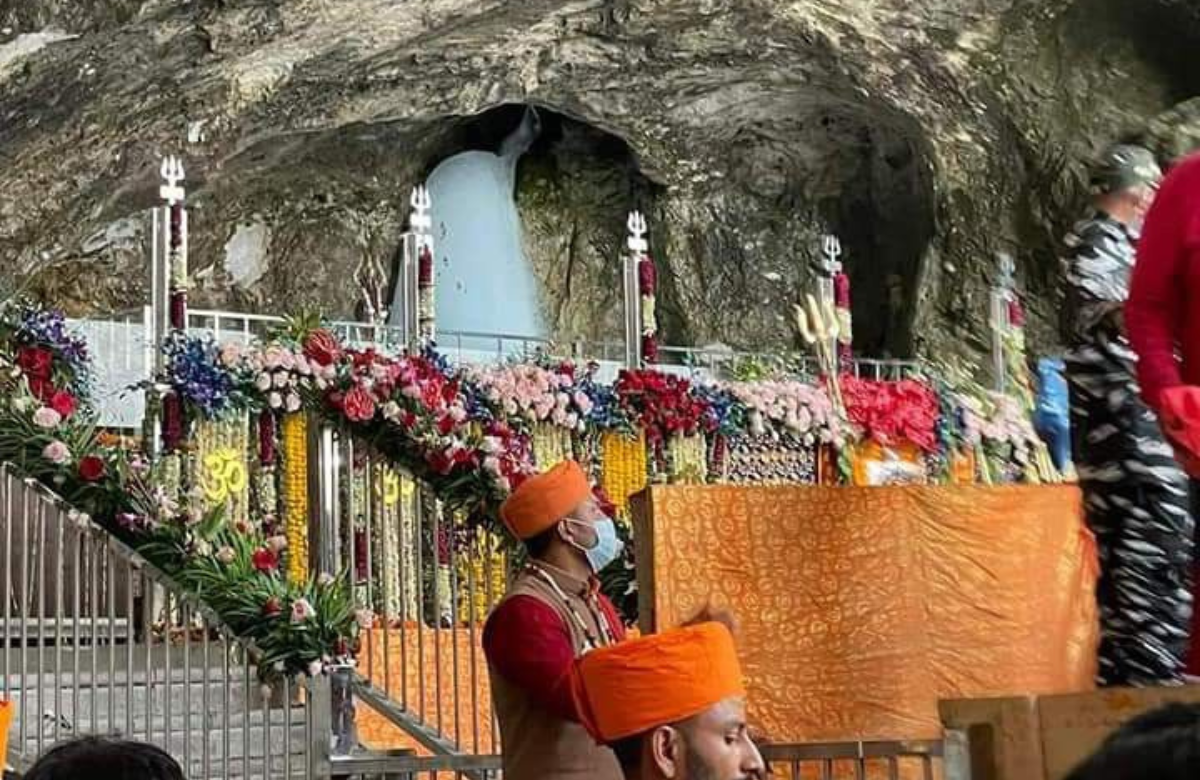
Stage 4 — Panjtarni to the Holy Cave: 6 km
The final 6 km of the pahalgam to amarnath distance by foot is the most emotionally charged section of the journey. The trail narrows as it enters the gorge leading to the cave, and the sound of devotional chanting and conch shells builds as you get closer. The Holy Cave sits at 3,888 m — the sacred ice Shivling inside forms naturally each year and is the reason every pilgrim has made this entire journey. Darshan queues at the cave can add 30 minutes to several hours depending on the day and season. Walking time for the Panjtarni to cave section is 2 to 3 hours. Ponies and dandis are available from Panjtarni for this final stretch. The total pahalgam to amarnath trek distance one way is therefore: 16 km (Pahalgam to Chandanwari) + 13 km (Chandanwari to Sheshnag) + 12 km (Sheshnag to Panjtarni) + 6 km (Panjtarni to cave) = 47 km. Minor route variations and sub-routes can bring this down to approximately 36 km or extend it slightly beyond 48 km. The round trip pahalgam to amarnath distance by foot is approximately 72 to 96 km over three to four days.

Chandanwari to Amarnath Distance by Foot: Starting Mid-Route
The amarnath yatra walking distance from baltal is the number that attracts pilgrims who have limited time or want to complete the darshan in a single day. At 14 to 16 km one way, the baltal to amarnath distance by foot is less than half the Pahalgam route. But shorter amarnath yatra walking distance from baltal does not mean easier — it means the same altitude gain is compressed into a fraction of the distance, resulting in a far steeper and more demanding single-day push. The Baltal base camp sits at 2,743 m. The Holy Cave sits at 3,888 m. The altitude gain over the baltal to amarnath cave distance is 1,145 metres — gained over 14 to 16 km instead of the 1,758 metres spread over 36 to 48 km on the Pahalgam route. The gradient is aggressive from the very first step and stays aggressive throughout. This is not a walk for anyone who has not done any high-altitude trekking preparation.
Baltal to Domel: 4 km
The first section of the baltal to amarnath distance by foot covers 4 km from the base camp at 2,743 m to Domel at approximately 2,987 m. The trail enters the narrow gorge immediately after the base camp and begins climbing steeply along the river. There is no gentle warm-up here. The path is rocky and the gradient is immediate. Most trekkers cover this section in 1.5 to 2 hours. Domel has a basic halt point with a medical facility and a tea stall.
Domel to Barari: 4 km
The second section of the baltal to amarnath cave distance covers 4 km from Domel to Barari at approximately 3,505 m. This is the hardest sustained climbing of the Baltal route. The trail switchbacks up through rocky terrain with altitude effects building noticeably above 3,000 m. The views of the surrounding cliffs and the gorge below are dramatic. Walking time from Domel to Barari is approximately 2 to 2.5 hours. There is a medical camp at Barari.
Barari to Sangam: 4 km
From Barari the baltal to amarnath distance continues 4 km to Sangam at 3,657 m — the junction point where the Baltal trail meets the Pahalgam trail descending from Panjtarni. The gradient eases slightly after Barari but the accumulated altitude makes breathing noticeably harder. Walking time from Barari to Sangam is approximately 1.5 to 2 hours. At Sangam, Baltal and Pahalgam pilgrims merge for the final approach to the cave.
Sangam to the Holy Cave: 2 to 4 km
The final section of the baltal to amarnath cave distance covers 2 to 4 km from Sangam to the cave at 3,888 m. The gradient eases on this final approach as the trail follows the gorge toward the cave entrance. This section is the most crowded of the Baltal route as pilgrims from both base camps converge. Walking time is 1 to 1.5 hours from Sangam. The return journey from the cave to Baltal base camp takes 3 to 4 hours on the descent — significantly faster than the ascent.

Pahalgam vs Baltal: Walking Distance and Altitude at Every Stage
This stage-by-stage breakdown shows the exact amarnath yatra walking distance, altitude, and trek time at every point on both routes — giving you a complete picture of what your body will encounter on each day of the journey.
Pahalgam Route
| Stage | Section | Distance | Altitude Range | Time |
| 1 | Pahalgam → Chandanwari | 16 km | 2130 → 2895 m | 5–6 hrs |
| 2 | Chandanwari → Sheshnag | 13 km | 2895 → 3590 m | 5–6 hrs |
| 3 | Sheshnag → Panjtarni | 12 km | 3590 → 4600 → 3657 m | 5–6 hrs |
| 4 | Panjtarni → Holy Cave | 6 km | 3657 → 3888 m | 2–3 hrs |
| Total | Pahalgam → Cave | ~47 km | Gain: ~1758 m | 3–4 days |
Baltal Route
| Stage | Section | Distance | Altitude Range | Time |
| 1 | Baltal → Domel | 4 km | 2743 → 2987 m | 1.5–2 hrs |
| 2 | Domel → Barari | 4 km | 2987 → 3505 m | 2–2.5 hrs |
| 3 | Barari → Sangam | 4 km | 3505 → 3657 m | 1.5–2 hrs |
| 4 | Sangam → Holy Cave | 2–4 km | 3657 → 3888 m | 1–1.5 hrs |
| Total | Baltal → Cave | ~14–16 km | Gain: ~1145 m | 1 long day |
Jammu to Amarnath Distance: The Full Journey from the Railhead
For the majority of pilgrims arriving by train from other parts of India, Jammu Tawi is where the amarnath yatra practically begins. Understanding the jammu to amarnath distance in full — road and trek combined — helps you plan your total travel time accurately and avoid the mistake of underestimating how long the journey from the railway station to the cave actually takes.
The jammu to amarnath distance breaks down into two distinct parts: the road section from Jammu to the base camp, and the trek section from the base camp to the cave. From Jammu Tawi to Pahalgam base camp the road distance is approximately 315 km, taking 6 to 7 hours. Adding the 36 to 48 km amarnath yatra walking distance from pahalgam gives a total jammu to amarnath distance of approximately 350 to 365 km, spread across four to five days of total travel. From Jammu Tawi to Baltal base camp the road is approximately 330 km, taking 8 to 9 hours. Adding the 14 to 16 km baltal to amarnath cave distance gives a total jammu to amarnath distance via Baltal of approximately 344 to 346 km — shorter in total distance but compressed into two days of travel. Most pilgrims arriving at Jammu Tawi by overnight train plan for an overnight stay in Jammu before the long road journey to the base camp. This is good practice — it breaks the journey into manageable segments and gives you one additional night of low-altitude rest before the altitude climbing begins. Jammu sits at just 327 m above sea level, so it is not an acclimatisation stop in the strict sense, but the additional rest day genuinely helps.
Kashmir to Amarnath Distance: From Srinagar to the Holy Cave
When people search for the kashmir to amarnath distance, they are typically asking about the road distance from Srinagar — the capital and main city of the Kashmir valley — to the Amarnath base camps, and then the walking distance from there to the cave. Srinagar is the nearest major city with an international airport to the amarnath yatra, and it is where most pilgrims arriving by flight begin the road section of their journey. From Srinagar, the road distance to Pahalgam base camp is approximately 96 km via the Anantnag highway — a journey of 2.5 to 3 hours. Combined with the 36 to 48 km amarnath yatra walking distance from pahalgam, the total kashmir to amarnath distance via the Pahalgam route is approximately 132 to 144 km. Via the Baltal route, the road distance from Srinagar to Baltal is approximately 93 km taking 2 to 2.5 hours. Combined with the 14 to 16 km baltal to amarnath distance by foot, the total kashmir to amarnath distance via Baltal is approximately 107 to 109 km. Most pilgrims flying into Srinagar spend at least one night in the city before heading to the base camps. This is worth doing both for acclimatisation — Srinagar at 1,585 m is a useful intermediate altitude stop — and because Srinagar itself is one of the most beautiful cities in India. A morning on a shikara on Dal Lake before the yatra begins is the kind of memory that frames the entire journey.
Katra to Amarnath Distance: Combining Two Great Pilgrimages
Katra — the base town for the Vaishno Devi yatra in Jammu — is a significant starting point for pilgrims who combine the Vaishno Devi darshan with the Amarnath yatra in a single trip. The katra to amarnath distance is longer than the direct Jammu to Amarnath journey because Katra sits approximately 48 km south-east of Jammu on a different road. From Katra to Pahalgam base camp, the road distance is approximately 355 to 360 km via Jammu — taking 7 to 8 hours by road. Adding the pahalgam to amarnath trek distance of 36 to 48 km gives a total katra to amarnath distance via the Pahalgam route of approximately 390 to 410 km, spread across five to six days of total travel including the Vaishno Devi yatra itself. From Katra to Baltal via Jammu and Srinagar the road distance is approximately 370 to 375 km, taking 8 to 9 hours. Adding the baltal to amarnath cave distance of 14 to 16 km gives a total katra to amarnath distance via Baltal of approximately 385 to 390 km. Many pilgrims structure this as a 10 to 12 day combined yatra package: fly or travel by train to Katra, complete the Vaishno Devi trek (13 km from Katra to Bhawan and back), rest for a day, drive to the Amarnath base camp, complete the amarnath yatra walking distance, and return to Jammu for the journey home.
What Actually Affects Your Walking Distance Experience
The amarnath yatra walking distance numbers are fixed — the trail does not change from year to year. But what changes dramatically is how those kilometres feel to different people. Understanding the factors that affect your walking distance experience helps you prepare specifically rather than generically.
Altitude Is Not the Same as Distance
The most important thing to understand about the amarnath yatra walking distance is that altitude changes everything. A flat 5 km walk at sea level takes most adults about an hour. A 5 km climb at 3,500 m with a 400 m elevation gain can take 2.5 to 3 hours for the same person. This is why the pahalgam to amarnath distance by foot of 36 to 48 km takes three to four days even though, on flat ground, that distance could theoretically be walked in a single long day. The altitude forces you to slow down whether you want to or not. The ones who fight this reality are the ones who develop altitude sickness.
Crowd Density on the Trail
On peak yatra days — particularly around Shravan Purnima and during the first and last weeks of the season — the trail becomes extremely crowded near the cave approach. This adds significant time to the final 6 km of both routes. Pilgrims who time their amarnath yatra walking distance carefully — arriving at the cave in the early morning hours rather than mid-morning — generally have a smoother darshan experience and a faster overall journey time.
Weather and Trail Conditions
Rain is the most common weather disruption on both routes. The stone trails of the Pahalgam route and the rocky paths of the Baltal route both become slippery and slower when wet. The Mahagunas Pass section on the Pahalgam route can be particularly treacherous in rain. Budget extra time on any day where rain is forecast. SASB sometimes temporarily suspends movement on sections of both routes during bad weather — carry a rain jacket and be prepared for unexpected halts.
Tips to Manage the Walking Distance Well
- Start every trekking day by 5 to 6 AM — the early hours have the best weather, the coolest temperatures, and the least crowd on the trail.
- Take the Pahalgam route if this is your first high-altitude trek — the gradual amarnath yatra walking distance from pahalgam spread over three days is far kinder to your body than the Baltal route's single brutal push.
- If you are taking the Baltal route, leave the base camp no later than 4 to 5 AM to ensure you complete the darshan and return before dark.
- Use trekking poles on both routes — they reduce knee stress on the descents by up to 30 percent and genuinely make the downhill sections of the baltal to amarnath distance by foot safer.
- Hire a pony for the Panjtarni to Holy Cave section if your energy is flagging — these 6 km are flat enough that most pilgrims walk them, but if you have pushed hard through the Mahagunas Pass section, pony support for this final stretch is sensible.
- Acclimatise for at least one night at your base camp altitude before beginning the trek — altitude sickness on day one of the walk is the most common reason pilgrims have to turn back.
Conclusion
The amarnath yatra walking distance is not one number — it is a set of distances that together describe a complete journey. The 16 km from Pahalgam to Chandanwari. The 13 km from Chandanwari to Sheshnag. The 12 km over the Mahagunas Pass to Panjtarni. The final 6 km to the cave. Or if you take the Baltal route — 14 steep and unrelenting kilometres from the base camp to the same sacred destination. Every one of those kilometres means something different on the ground than it does on paper. The distance from Sheshnag Lake to the Mahagunas Pass is 12 km on the route map. In the body of a pilgrim crossing it at 4,000 m, it is something else entirely. Know your amarnath yatra walking distance before you go. Train for it seriously. Choose your route honestly based on your fitness and time. And when you finally stand inside that cave at 3,888 m, breathless from altitude and devotion in equal measure, every single kilometre of the journey will have been worth it.